
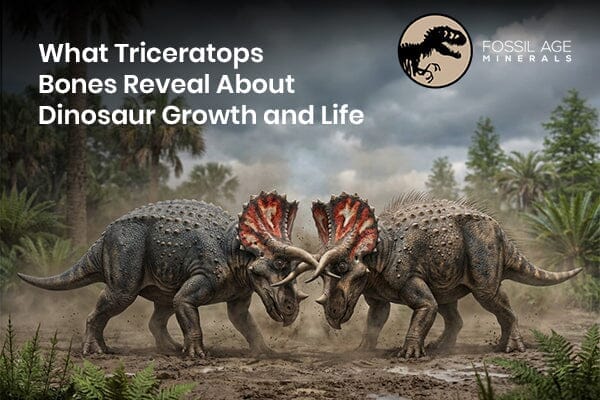
Each Triceratops bone provides a direct link to one of the best-known creatures of the Late Cretaceous period. These fossil remains show not only how this three-horned herbivore looked, but also how it lived. They show how it developed, moved, and survived in the ancient terrain, which was full of threats and challenges.
The inspection of the shape, density, and structure of bones explains how Triceratops grew from a small hatchling into an enormous horned adult.
Understanding Growth From Early Life to Adulthood
Triceratops's body began small, but its bones show how it grew rapidly. The growth rings within the fossilized bone—similar to tree rings—display distinct periods of development, suggesting steady growth followed by a marked increase in size.
As Triceratops aged:
- Limb bones thickened to support greater weight
- The skull expanded to accommodate horns and a frill
- Bone density increased for strength and stability
- Joints became more robust for movement
These changes reveal a gradual transformation from a vulnerable juvenile into a heavily built adult capable of defending itself.
Bone Strength and Daily Movement
The Triceratops limb structure shows it had to bear significant weight. Its legs were positioned directly beneath the body to maintain balance while moving across ancient plains and forests.
With strong limbs, Triceratops could:
- Walk long distances while grazing
- Support its heavy head and body
- Maintain stability on uneven terrain
- Move steadily despite its large size
The thickness and density of these bones suggest that Triceratops relied on strength and endurance rather than speed.
What Skull and Horn Bones Suggest About Behaviour
The Triceratops skull is one of its most distinctive features. Its large frill and three horns reveal insights into its behavior and survival strategies.
Skull and horn bones served to:
- Provide protection against predators
- Enable visual display for communication
- Support strong jaw muscles
- Provide structural support for the neck
The frill also likely played a role in muscle attachment, helping support the massive head and jaws needed for feeding.
Feeding Habits of Triceratops
Triceratops had strong jaws adapted for tough vegetation. Its teeth were designed to slice and grind plant material efficiently.
The jaw structure indicates:
- Powerful chewing ability
- Adaptation to tough plant material
- High chewing frequency
- Feeding on low-growing vegetation
This diet likely included ferns, cycads, and shrubs. Tooth wear patterns suggest continuous grazing throughout its life.
How Fossilized Remains Reveal Daily Life
Complete and partial Triceratops fossils provide insight into their size, posture, and movement. These findings suggest a ground-dwelling lifestyle with steady, sustained movement.
Variations in fossil size and structure also indicate differences in growth rates, likely influenced by environmental conditions and food availability.
Growth Patterns and Lifespan Clues
Bone thickness and structure reveal how Triceratops developed over time. As it aged, its bones became stronger to support its increasing body mass.
Growth patterns suggest:
- Long-term development over many years
- Increasing strength with age
- Ability to support large horns and frill
- Structural adaptation to body size
These features reflect a life cycle shaped by growth, survival, and environmental adaptation.
Conclusion
The fossil record continues to reveal new insights into the life of Triceratops. From early development to adulthood, bone structures show how it adapted and survived in prehistoric ecosystems.
The complete Triceratops skeleton highlights how each bone contributed to a strong and stable framework. Fossil Age Minerals offers authentic specimens for those interested in exploring real dinosaur history.
Explore Fossil Age Minerals to discover genuine fossils and gain a deeper understanding of life millions of years ago.


