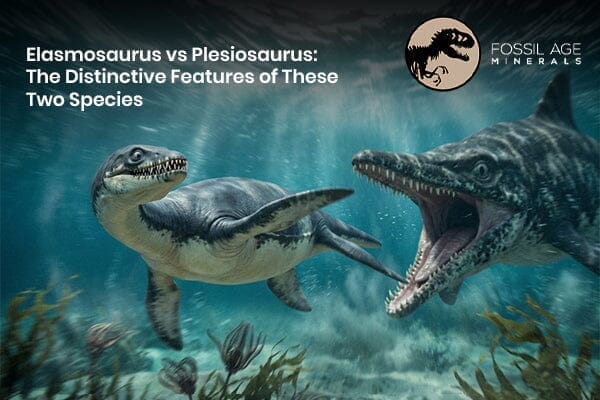
Even as the Elasmosaurus represented just one species among the various kinds of prehistoric sea reptiles, it still had some special physical characteristics. One notable aspect about the Elasmosaurus was its extremely strange physical appearance caused by its unique neck.
There were similarities between the physical features of Elasmosaurus and other kinds of sea reptiles at that time. At the same time, there were certain physical aspects about the Elasmosaurus that differentiated it significantly from the others.
Most Distinctive Characteristic of Elasmosaurus
One of the most distinctive characteristic of the Elasmosaurus was its exceptionally long neck, accounting for half of its body length. Other than being a characteristic of this species, the elongated neck served an important purpose. It helped the animal use its elongated neck as camouflage in ambushing its prey.
It looks unlikely that this sea predator chased after its prey but stayed at the bottom of the ocean. Thanks to its small head positioned on its elongated neck, it could ambush its prey such as fish and squid.
How Did Body Shape Affect Movement?
Although the elongated neck is notable, the body of Elasmosaurus also played an essential role. This included a wide, flattened body with four paddles that synchronized for a smooth, gliding swimming action.
This body configuration resulted in:
-
Control over speed
-
Endurance over sudden bursts of energy
-
An advantage in stability when swimming
This is the opposite of other marine reptiles, which had features suited to quick chases.
Plesiosaurus: Structurally Different?
Examining the Plesiosaurus reveals the disparities. The creature had a relatively short neck and its flippers were located at the front. Its proportions were significantly varied from those of the Elasmosaurus. Given its slightly larger head relative to its body size, its neck was noticeably shorter.
Such a disparity would have meant the Plesiosaurus had a varied hunting strategy. With a much shorter neck, it had relatively faster body movements, which gave it lethal predatory abilities instead of stealthy hunting skills.
Comparing the two species shows distinct differences; however, there could be common aspects when their environments are considered.
How Their Surroundings Shaped Their Survival
Despite belonging to the larger family of marine reptiles, the two animals could have lived very different lives and demonstrated upside-down behaviours. An educated guess turns the long neck of Elasmosaurus into what it may have been used for: searching for food in deep water.
Plesiosaurus's habitat demonstrated its adaptability across different ecosystems, suggesting that it lived in shallow coastal waters, which, in turn, shaped many aspects of its life history and dietary patterns.
Also of critical importance to the morphology of these creatures were their habitats, which were very much meant to serve the purpose of their body forms.
How Their Diet Shaped Their Behaviour
Feeding behaviours partially shape each species, and these two reptilians were no exceptions. Elasmosaurus probably picked off smaller, agile prey, using its long neck to grasp fish without causing significant water movement.
In contrast, Plesiosaurus could have targeted some slightly larger or faster-moving prey, putting all its various body structures into play. Just as with the more explanation in their feeding habits, their methods of hunting and kinds of prey must indeed have differed.
This difference in feeding gained then becomes a cardinal cause of setting them apart from their rather similar general looks.
Why Do These Differences Matter Today?
Exploring prehistoric animals helps us better understand their intriguing and enlightening role in how living organisms change over time. In fact, Plesiosaurus and Elasmosaurus differ in their outward appearance so much so that in the same build or even minor changes in the physical build lead the two to completely different Adaptive Pathways.
In the present contrast, evolution can be traced as never before, ecological balance can be covetously measured, and profound changes in sea life stare the man in the face, caught in a network of stabilized and ideal inclusiveness.
Key Differences Between Elasmosaurus and Plesiosaurus
The study of the elasmosaurus and plesiosaurs reveals the two-way nature of these animals, which cannot be reduced to mere variants of a single concept. The former pursues excess for distance, down to extinction; the other, maximum balance without losing agility.
The study highlights the sophistication within the same category that can survive in a specific ecological niche, where even closely related organisms occupy their own unmovable spots.
Discover More With Fossil Age Minerals
If you are interested in the history of marine life, Fossil Age Minerals can grant you access to genuine fossils that unfold these little historic narratives of days gone by. In their efforts to provide only the best-of-line items and specimens, they are the hub of every enthusiast's collectibles or entanglements with nature.
It is a chance to hold evolution in your hands and allow it to take you back through the unearthly world where these creatures held rites.


