Long ago, the world's oceans looked very different than what we see today. Large coral reefs flourished in the tropical waters, strange sea creatures crawled on the ocean floor, and the vast majority of marine animals left behind signs of their life. Many of these traces, over very long periods, became fossilized, telling us an amazing story of Earth's past.
One of the most stunning examples is fossilized coral that retains the complex designs of ancient reefs. These fossils not only reveal the marine life that existed even before humans, but are also fascinating to collectors, scientists, and lovers of nature.
How Do Marine Fossils Form?
Most marine fossils form when a creature dies and settles to the bottom of the ocean. If the alignment is proper, the dead body gets covered bit by bit under new layers of sediment. Over time, minerals can replace organic material, preserving the form and tissue structure of the original organism.
Various elements affect the formation of fossils:
-
A quick burial in sediment
-
Scarcity of oxygen to decompose the body slowly
-
Groundwater laden with minerals
-
Unchanged geological settings for extensive periods
Since these are rare conditions, each well-preserved marine fossil is indeed a spectacular geological event.
Why Coral Fossils Are So Fascinating
Ancient coral reefs nurtured a dazzling variety of marine life. Like their modern counterparts, they were environments that provided food, shelter, and breeding grounds for more species.
Fossilized coral often preserves not only its form but also its complex textures and growth patterns. Fossil corals thus provide scientists with insight into:
-
Oceans in the past
-
Sea level changes
-
Marine life diversity across time
-
How the environment has changed
Some fossil corals are more than 100 million years old. These fossils are an important source of data about life on Earth and the climate of our planet.
A Window Into Ancient Underwater Communities
Fossils of coral are rarely found alone, and many are discovered in association with other marine fossils that once lived in the same environment.
Typical finds include:
-
Brachiopods Crinoids
-
Trilobites
-
Ammonites
-
Prehistoric mollusks
These organisms, together, provide a more comprehensive representation of ancient undersea ecosystems, which can be analyzed to understand a lost habitat and its inhabitants.
The Curious Story of the Sand Dollar
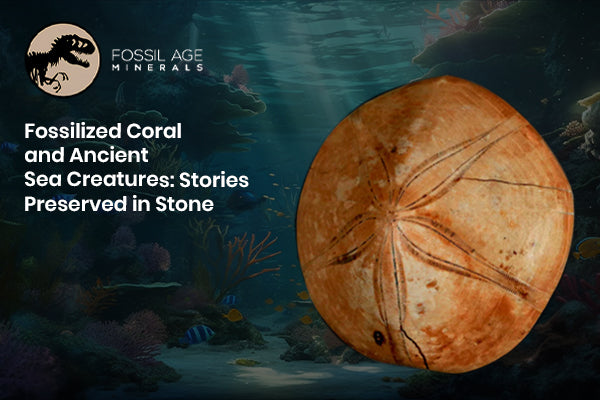
The sand dollar fossil is one of the most recognizable of all marine fossils. Sand dollars, in their present form, belong to the echinoderms, a group that also includes species such as the sea star and the sea urchin.
Their flattened body shape allows them to live half-buried in the sandy ocean floors. Their fossilized remains, which often contain the distinctive sand dollar pattern, can be useful to scientists and appealing to collectors.
Fossilized sand dollars can also help scientists determine where seas once were. Their remains can be used to recognize places that were once shallow marine habitats – even if they’re now far from the sea.
More Than Just Beautiful Collectibles
Marine fossils are beautiful, but scientific value is also important.
Marine fossils allow specialists to answer questions such as:
-
What marine species lived in Earth’s oceans?
-
How have marine ecosystems shifted over time?
-
What geologic events drove evolution?
-
How have coastlines moved over geologic time?
Each fossil adds a piece to the ongoing jigsaw puzzle. Even the smallest fossils can help when compared to other finds.
Why Ancient Sea Creatures Continue to Inspire
There is a kind of attraction to clutching a fossil that has been preserved for millions of years. In contrast to the contemporary objects that we can see and have experienced, fossils let us encounter natural history in a time span far beyond our own capacity to comprehend.
From the geometric ornament of a coral to the subtle symmetry of a sand dollar or the remains of ancient marine animals, fossils are reminders that our Earth has undergone innumerable changes. Oceans have grown and retracted, species have come and gone, and ecosystems have evolved and evolved again.
Conclusion
Marine fossils are marvelous expressions of life beneath the Earth's most ancient seas—from coral reefs teeming with life millions of years ago to prehistoric sea mammals that roamed ancient oceans and sandy seafloors.
Sea urchin fossils and other collectible fossils continue to be highly prized by collectors today for scientific significance as well as sheer aesthetics.
If you’re looking to discover genuine marine fossils and learn more about the fascinating ancient worlds those fossils help paint for us, Fossil Age Minerals offers a growing selection that makes these powerful facets of natural history more accessible, even to the modern-day collector and enthusiast.


