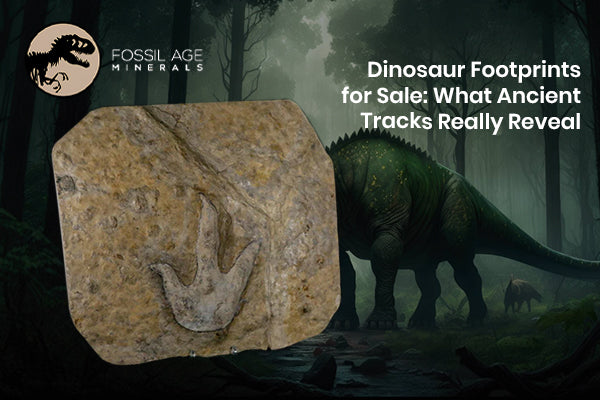
The desire to own dinosaur footprints for sale is much more than owning a fascinating fossil. While bones and teeth are just evidence of what a dinosaur looked like, footprints tell us something else altogether, something much deeper. Unlike anything else out there, these tracks capture a moment frozen in time, giving us insight into the behavior of dinosaurs from ages past.
Skeletal remains tell us how a dinosaur looked; footprints tell us what a dinosaur did. They show us if an individual walked slowly, ran through soft ground, or traveled in company. Footprints are one of the rarest kinds of fossils we know, since they are evidence of an event that can never happen again.
Why Aren't Dinosaur Footprints the Same as Dinosaur Bones?
Most individuals consider fossils to be skeletons that have been preserved beneath many layers of rock. However, prints are not classified as body fossils but as trace fossils. As opposed to the former, the latter preserves traces of actions rather than actual structures.
The prints were formed when a dinosaur walked on a soft layer of either sand or mud. If this layer were soon covered by sedimentation, the depressions had a chance of becoming fossils.
This is the main reason why prints are highly useful.
Dinosaur Bones vs. Dinosaur Tracks
|
Dinosaur Bones |
Dinosaur Footprints |
|
Show what a dinosaur looked like |
Show how a dinosaur moved |
|
Preserve body structure |
Preserve behavior |
|
Form after the animal dies |
Form while the animal is alive |
|
Reveal anatomy and size |
Reveal speed, direction, and movement |
|
Often discovered as isolated remains |
Sometimes preserved as complete trackways |
How Does a Footprint Survive Millions of Years?
The survival of a footprint involves a unique set of circumstances. Footprints tend to vanish fast due to wind, rain, and the flow of water. It is rare to find some footprints that have managed to last until they become fossils.
The following process usually occurs:
-
The dinosaur walks over loose sediment
-
The footprint does not get destroyed
-
New layers of mud/sand deposit over the footprint
-
Minerals turn the layers into stone
-
Exposure occurs after geological processes
For each event to happen in that order, it is amazing how fossilized footprints are naturally preserved.
What Can a Single Footprint Tell Us?
At first sight, a footprint might just look like a mere impression in the rock. However, the footprint of a dinosaur can give us many interesting things to consider regarding prehistoric creatures.
Based on its size, depth, and appearance, scientists will be able to determine the following about a particular dinosaur:
-
Approximate size
-
Speed of movement
-
Direction of travel
-
Distribution of body weight while moving
-
Softness of the Earth
The spacing between two prints will allow scientists to understand whether the animal moved quickly or slowly across the terrain.
Far from depicting only one thing, such an imprint can become very informative.
Reading an Ancient Journey Through Trackways
Fossilized tracks come not only in single form; rather, they can be seen as complete trackways covering large areas of rock surface. This provides an opportunity for scientists to trace out the movement pattern of the animal at that time.
These could have possibly provided information about:
-
Migration pattern
-
Feeding habits
-
Group movements
-
Change of pace
-
Interaction between different species
There are instances where tracks left behind by different dinosaurs overlap each other in one area, thereby providing evidence of different animals living in the same region.
What Different Footprints Can Reveal
Not all dinosaur footprint fossils share the same appearance. Footprint structure can indicate both the physical traits and behavioral characteristics of the dinosaur.
Some examples include:
-
Tracks with three toes were usually left by meat-eating theropods.
-
Wide tracks can often be traced to herbivores.
-
Small tracks could belong to juvenile dinosaurs.
Additional information, such as stride length and depth of the print, can reveal more details about the dinosaur’s body type and movement. This is because footprints show how dinosaurs adapted to their environment, in contrast to bone fossils that depict only physical traits.
Every Track Is Part of Earth's Story
Dinosaur tracks continue to be some of the most impressive fossils due to the fact that they show motion rather than anatomy. They tell the story of something happening, in this case, a dinosaur walking through an area that was at one point covered with sediment, but has since turned to rock. This particular instance may have taken place millions of years ago, but the story is told nonetheless.
The appeal for dinosaur tracks for sale can be traced to the interest in fossils that are not only historical but also tell the story of prehistoric actions. Those interested in collecting such fossils will find that Fossil Age Minerals have just what they need.


