Morocco has gained an outstanding reputation among fossil lovers for the breathtaking variety of fossils found in its ancient rock strata. The craze for Moroccan fossils for sale is an indication that people are becoming more familiar with the country's geological past and with the amazing creatures that inhabited its land and sea.
Morocco, from the remains of ancient trilobites that once moved on the bottom of prehistoric seas to humanly inescapable fossilized shark teeth, opens a unique door to the Earth of ancient times. Such findings still show that the planet was home to very different kinds of living beings before the human species made its appearance.
A Land Shaped by Ancient Seas
A long time ago, large areas of Morocco were covered by shallow seas. These marine areas housed various kinds of life, many of which were fossilized in sediment layers.
After that, natural geological processes transformed these sediments into rocks, and at the same time, they created the best fossil preservation conditions. Today, for example, the Atlas Mountains and the nearby desert areas are famous worldwide as great fossil places.
Fossil-bearing rock layers show the existence of:
-
Old marine habitats
-
First primitive arthropods
-
Extinct fish species
-
Marine dinosaurs
-
Various invertebrate creatures
Every time we discover a new fossil, we get closer to picturing those habitats that existed hundreds of millions of years ago.
The Remarkable Diversity of Moroccan Fossils
Among the reasons why Morocco is considered one of the world's major fossil-producing areas, one is undoubtedly the astonishing range of specimens recovered there. Fossils dating to several geological periods have been found, providing different glimpses into Earth's history.
Typically found are:
-
Trilobites
-
Fossilized shark teeth
-
Ammonites
-
Orthoceras fossils
-
Marine reptile bones
-
Fossil fish
Such a variety provides a more comprehensive view of how organisms changed as their environments and the eras around them evolved.
Unlike fossils from only one isolated prehistoric ecosystem, fossils from Morocco come from many different geological formations and time periods, thus making it possible to learn more about the constant change in life.
Why Trilobites Are Among Morocco's Most Famous Fossils
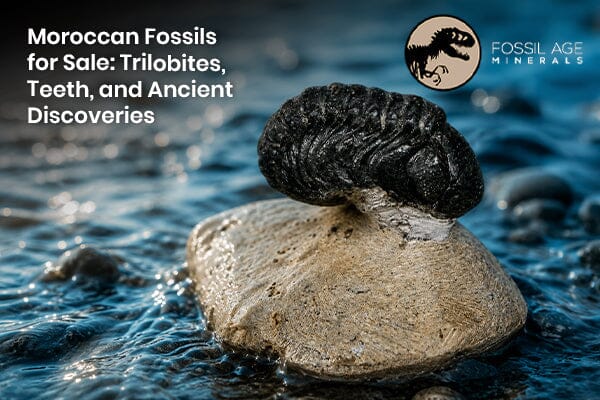
Moroccan trilobites are among the most iconic fossils from Morocco. These extinct marine arthropods once thrived in Earth's oceans over several periods before being wiped out in the Permian mass extinction.
Trilobites had segmented bodies, compound eyes, and unique shapes that make them attractive fossils to geologists.
Trilobite fossils provide insights into:
-
First marine life forms
-
Evolving features
-
Diversity of ancient seas
-
Historical changes in the environment
Many fossils are so well preserved that they show the organism's sculpture and appearance in great detail.
Since trilobites spanned a vast timeline, they serve as markers for changes in life forms during various geological periods.
Fossilized Teeth and Ancient Predators
Trilobite fossil Morocco are also renowned for fossilized teeth of all kinds. Most frequently, these fossils are of sharks and other marine predators that inhabited the ancient seas.
Teeth are usually the most durable parts of an animal, so it is only logical that they are the ones most commonly found as fossils. Besides, the shape of the tooth can reveal a great deal about the animal's diet and its niche in the prehistoric environment.
Through studying fossilized teeth, scientists are able to:
-
Determine which animals were preying on each other
-
Track how the diets of animals evolved
-
Estimate the number and kinds of various species
-
Trace historical alterations in marine ecosystems
Having knowledge of these factors gives a possibility to researchers to create a comprehensive picture of the complex underwater food chains of bygone times.
What Moroccan Fossils Reveal About Earth's Past
Altogether, the fossil findings in Morocco add up to an amazing chronicle of life over extremely long periods of geological time. Different fossils represent different stages of the Earth's history, showing through their remains how the climate changes, seas with new locations, and living things with new forms.
These examples offer the possibility to map:
-
Environmental changes of very long time ago
-
Marine species diversity through the ages
-
Evolutionary tracing
-
Great extinction incidents
Every fossil delivers an additional detail to the vast narrative of Earth's past, thereby linking a single finding with wider trends in nature.
The Legacy of Morocco's Fossil Record
The fossil-rich lands of Morocco still present important windows into the past life on Earth. The range of fossils from seashells and marine creatures to the remains of top predators bears witness to the remarkable variety of living beings that at one time populated the different ancient environments.
The trilobite fossil, which Morocco is famous for, is a distinguished example of such a fossil that still enthralls a large number of people with its exceptional preservation and its link to some of the oldest complex life forms on our planet.
If you happen to be a fan of collecting genuine fossil specimens, Fossil Age Minerals are the ones who deal with only the well-sourced fossils that can be used to practically touch and see the natural history.
Look through their catalog to find authentic fragments of Earth's remote times that will serve as a continuation of your exploration of the prehistoric world.


