
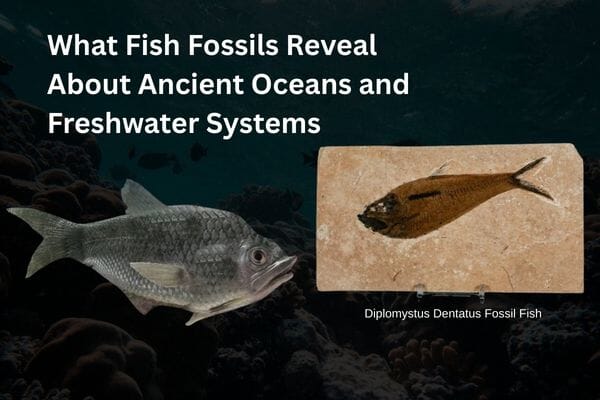
Long before continents settled into their present shapes, Earth’s waters looked very different. Seas spread across land that is now dry, while rivers and lakes formed networks that no longer exist. A fish fossil offers one of the clearest records of these ancient aquatic worlds, preserving direct evidence of how oceans and freshwater systems once supported life.
Because fish lived in nearly every water environment, their fossils help scientists piece together how ancient ecosystems functioned, changed, and disappeared over time.
What Do Fish Fossils Tell Us About Ancient Oceans?
The presence of fish fossils far from the sea or at high altitudes indicates that large land areas were once submerged beneath shallow seas. The fish fossils are typically of species better adapted to calm, warm waters, unlike those found in deep oceans.
The following can be deduced from the anatomy of the fish:
-
Whether the water was shallow or deep
-
If the environment were tropical or temperate
-
How stable were marine conditions over long periods
When certain species of marine fish are found, it would confirm that the ancient oceans shifted cyclically, flooding and retreating across continents.
Freshwater Systems Left a Distinct Fossil Record
Freshwater systems do not leave behind the same fossil evidence as the oceans. Many fish fossils were entombed in ancient lakes, river bottoms, and floodplains, where terrifying water conditions preserved exquisite features over time. Such environments have sometimes been less frequently disturbed than open sea surfaces. Such conditions are characteristic of detailed fossilization. Freshwater fish fossils clearly reflect the prolonged stability of lakes spanning several millennia, the support of dense aquatic life by river systems, and frequent alternation between flooding and drought.
Cumulatively, these fossils tell us just how much spread, complexity, and ecological richness existed in freshwater environments once upon a time, far beyond the imagination of modern people.
How Do Fish Fossils Reveal Water Conditions?
The physiology of fish is adapted closely to the environment. Over millions of years, even tiny differences in this context contributed the most to shaping fish evolution.
Physical signs found in fossils provide evidence regarding:
-
Water clarity based on eye placement
-
Oxygen levels are reflected in the gill structure
-
Flow strength suggested by fin shape
As we know about layer deposition, there are gradual environmental transitions rather than abrupt changes, which helps us understand how systems changed over time in an aquatic environment.
From Ancient Waters to Modern Collections
As fossils moved from scholarly confines to private collections, public interest in ancient aquatic life surged. This has driven numerous people into an arena where fossils can be encountered through educational exhibits or by prime fossilized fish for sale, lovingly imported from known fossil beds.
Even when well documented, the context is preserved: whether the species, preservation style, and geological context allow us to say that the fossil lived in marine shallows, river systems, or prehistoric lakes.Why Location Matters in Interpreting Fish Fossils
Where a fossil comes from is almost more intrinsic to the fossil than the fossil itself. Certain fish species only lived in specific environments.
For instance:
-
Reef-dwelling fish hint at coral-rich marine environments
-
Benthic species suggest a muddy or silty water setting
-
Schooling fish point towards nutrient-rich ecosystems
By mapping these fossils, scientists can place them within a vast landscape of the past that predates individual ones.
What a Prehistoric Fish Fossil Still Teaches Us
A fish-inspired fossil is more than a mere fossil. It is actually a quite profound statement, shaped by Earth's environmental history, that shows how oceans and freshwater systems fared under long-standing climate and geological transformations.
Fossil Age Minerals connects collectors and educators with responsibly sourced fossils that reflect Earth’s ancient past. For collectors, educators, or would-be enthusiasts, these pieces resonate with a real sense of soul connection to ancient aquatic habitats that once shaped life on Earth.


