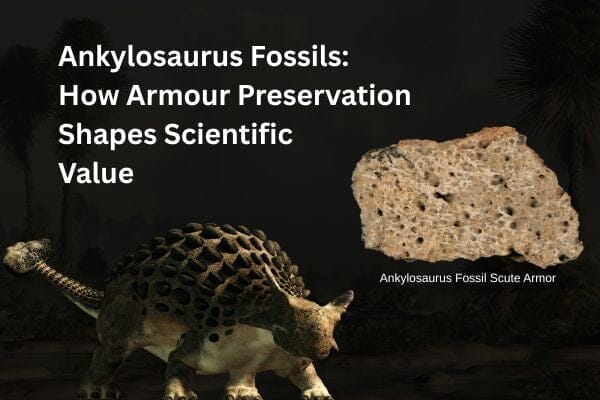
In dinosaur history, one of the most remarkable factors is the heavy, bony armor of the Ankylosaurus. Unlike other dinosaurs, this armoured herbivore carried diverse armour plates, tail spikes, and a tail club that helped it survive. The degree to which these parts are preserved in the fossil record directly determines the extent of study and knowledge that can be acquired by scientists, thus making armour preservation a highly important research goal rather than yet another visual pleasure.
Below are six focused sections, each exploring how the condition of an artifact affects research value, interpretation, and long-term understanding.
1. Armour as a Record of Biology, Not Decoration
The function of the armor of Ankylosaurus is not only a defense against the environs. Every plate or osteoderm speaks to its growth periodic patterns, defense strategies, and even the cause of death, provided the skin remains preserved at central levels.
What should be looked at is the following:
-
Plate dimensions, row patterns
-
Regional variation in body anatomy
-
Variation in a species from natural growth
Poor preservation removes this biological record, limiting what can be reliably concluded.
2. Why Armour Preservation Is Rare
Armor does not hold up well. Osteoderms often lose their place or crack, forming soils that are displaced during burials. It is hard to find properly preserved fossils.
Several factors affect preservation:
-
Speed of burial after death
-
Type of sediments and the amount of pressure overlying the fossil
-
Location and co-effect of water movement during fossilization.
This makes even partially preserved armour reconstruction scientifically rewarding.
3. Interpreting Behaviour Through Armour Condition
Preservation of the armor provides more information about the types of interactions between the Ankylosaurus and predators, as well as with the surrounding environment, through patterns of damage, healed fractures, and wear marks in the armor, while suggesting defense behaviors and repeated impacts.
One wrong move and those clues would be lost. In the meantime, armour that remains in the petrifaction-corrected place and condition informs us about the animal, rather than just about its look.
4. Preparation in Preserving Meaning
Preparation is very important when maintaining armoured dinosaurs. If one overdoes it (cleaning excessively or over-stabilising), the overzealous work can detract from the recovery and value of the surface details necessary for identification.
A well-preserved ankylosaurus fossil, on the other hand, typically retains:
-
Spaces between armour plates
-
Survival of surface textures
-
Visual contrast between the septarium (bone formation) and the surrounding aspect
These details lend invaluable assistance to scientists in preventing incorrect inferences, whether by improving accuracy or by serving as a basis for research.
5. Armour Context Matters More Than Completeness
A fossil does not necessarily need to be complete to be useful. Armor preserved in its original position tells a clearer story than isolated plates with no context.
The following, among others, represent qualities military researchers cherish in the studies of fossils:
-
The relation between armor and the bone beneath
-
Arrangement on the body
-
Consistent with anatomical patterns that are known
Often, contextual completeness will carry more weight than visual completeness in determining scientific worth.
6. From Armour to Whole-Body Understanding
The incorporation of armour with bones enhances a paleontologist’s comprehension of the animal’s anatomy and locomotion. This becomes particularly crucial when determining how the armor integrates with the muscles and joints.
In more well-documented cases of skeletons, the armor helps build posture, defense mechanisms, and the body's overall shape. Indeed, a broader understanding of the bones is required when examining the ankylosaurus skeleton, as the armor will also affect the overall appreciation of the animal.
Conclusion: Preserving Knowledge, Not Just Fossils
The preservation of the ankylosaur's armor determines how informative the information the fossils it left behind can be. We can pass over the anatomy and armament preserved in the remains of a well-preserved armor covering.
Fossil Age Minerals has been working to provide ethically sourced, fully documented fossils as educational aids for collectors.
If you find fossils that favor what natural science and responsible treatment might mean, going with Fossil Age Minerals to look into those well-documented fossils is only wise.


