
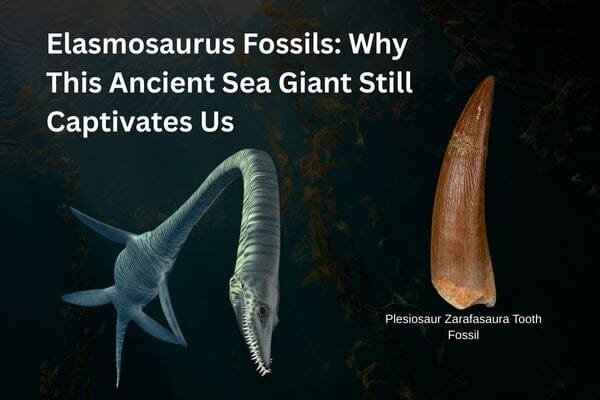
Elasmosaurus was among the creatures that inhabited the prehistoric oceans and seems to have been a mythic creation. Among the most compelling marine reptiles ever found, it carries an air of mystery even after years of discovery. The creature's striking size, its oceanic adaptation, and its clandestine life captured the hearts of all people. There can be little doubt that specimens are more than simple representations of a species: they are windows into how the seas functioned in ancient times, supporting life that adapted to those immense underwater worlds.
All the fascination in these fossils unfolds gradually as we scrutinize them further.
What Made Elasmosaurus So Different From Other Marine Reptiles?
The unique body of the Elasmosaurus was unparalleled in the history of ancient seas. The uniqueness of this animal, however, first became apparent from the features of its unconventional body, namely, an irresistibly long neck. Such distinct body proportions were not evolutionary exuberances, however; they all seemed to aid the animal's survival and hunting.
-
The elongated neck, with an extraordinary number of vertebrae, provided Elasmosaurus with a much greater reach than that of other marine reptiles.
-
This length probably allowed it to approach prey slowly without moving its bulky body much.
-
Keeping the main body at a distance may have reduced water disturbance during hunting.
-
The assigned predator thus carried a hunting style that favored waiting and aiming rather than relying on speed or power.
Anatomy That Still Challenges Assumptions
Elasmosaurus's anatomy today forces us to rethink how marine reptiles moved and fed. It had long, sturdy fins made for steady swimming, with an eye to parsimonious energy expenditure in the open ocean. The rib architecture suggests the animal had robust lungs and was designed for long dives.
These anatomical hints paint the picture of a creature built for stamina, something that would hold one in good stead offshore.
Why Are Elasmosaurus Fossils So Rare?
Marine environments are harsh on remains; hence, an Elasmosaurus fossil that is beautifully preserved is considered rare. Unlike land animals, which may be buried in sediment quickly, marine reptile fossils are left to the manifold wrath of currents, scavengers, and decay.
So fossils are mostly partial remains rather than complete skeletons. Any such discovery is to be treasured not so much for its completeness, but for what information it can yield later."
What Do These Fossils Tell Us About Ancient Oceans?
Elasmosaurus fossils have been discovered alongside the remains of other marine life, helping reconstruct entire ecosystems. It is possible to infer from these discoveries:
-
Feeding relationships between predators and prey
-
Water Depths and Temperature during the Cretaceous Period
-
Some sporadic patterns of reptilian seaward migration
-
Great seaward marine life diversity during the Cretaceous period
It is easy to stand all of them in plain view, but barely beside each other. But together, they offer a hint of interpretation of the now-dead symphony that signaled the life caught within diverse prehistoric marine ecosystems.
A History of Scientific Debate and Discovery
Early Elasmosaurus fossils were misinterpreted, with the head placed on the tail, vividly underscoring the mystery that early paleontologists faced. This revolutionized the classification and study of marine reptiles.
All fossils were then endowed with a very deep aura of history, showing that evidence accumulated to prove not one good assumption.
Is Elasmosaurus Really a Dinosaur?
Even though it is common to refer to Elasmosaurus as a dinosaur, it is not a dinosaur. It was a rather large marine reptile that coexisted with dinosaurs, seeking water but taking a completely different evolutionary trajectory.
This differentiation makes it apparent why the Elasmosaurus fossil remains seem so outlandish. Such fossils indicate a distinctive make-believe underwater universe that was contrary to that of terrestrial evolution.
Conclusion: Preserving the Story Beneath the Waves
Elasmosaurus dinosaurs are rare for a reason. The skeleton itself is not particularly distinctive among other well-known marine predators, such as plesiosaurs, mosasaurs, snakes, long-necked turtles, and other deep-sea creatures. Still, its significance lies in its relative peculiarities.
At Fossil Age Minerals, excellently sourced marine fossils connect accurate knowledge with curiosity. Minding all kinds of collectors and students, exploring these specimens provides them with a means to comprehend Earth's deep past, even that one fossil.


