
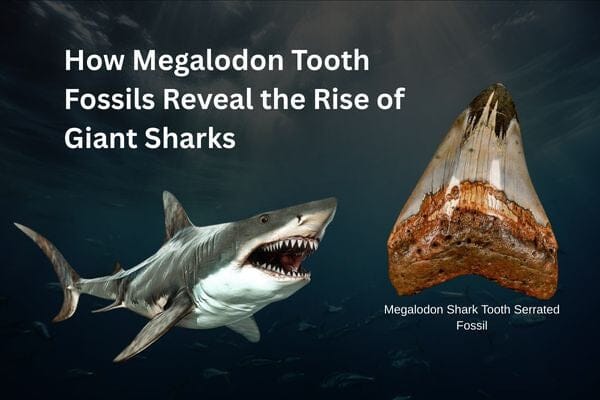
The evolution of giant sharks across millions of years of ocean history, and some of the clearest evidence comes from a single source — the megalodon tooth. The large fossilized teeth from this period have remained intact since the extinction of sharks, allowing researchers to study their evolution through prehistoric times.
Sharks are unusual animals because they are mainly made of cartilage, which prevents them from having a skeleton; they have very tough teeth that fossilize readily and are preserved in sedimentary rocks. Investigations of these teeth help reconstruct the evolutionary history that enabled the development of the largest shark species.
Stage 1: Early Shark Ancestors
Sharks first appeared more than 400 million years ago, which happened before dinosaurs existed on Earth. The earliest shark species were smaller than the enormous sharks that later became dominant in the ocean. Their teeth design contained fundamental elements that enabled them to capture both small fish and soft-bodied marine animals.
Sharks evolved after ocean ecosystems had reached their most advanced state. The species developed more powerful jaws and sharper teeth in response to changes in prey size and environmental conditions. The evolution of giant sharks began with early species that showed gradual changes in dental structure and function which their fossilized teeth.
The main attributes of the original shark teeth showed
-
Smaller size and simpler shapes
-
Smooth edges suited for gripping prey
-
Narrow crowns designed for quick bites
-
Limited serration compared to later species
The early sharks developed these traits to survive in their habitats, yet these traits laid the foundation for their subsequent evolutionary development.
Stage 2: The Rise of Giant Sharks
Shark species have increased in size over their existence because the marine environment has expanded over the past two million years. The availability of abundant food and suitable climatic conditions enabled certain predators to attain the highest levels of predatory power. Fossil evidence shows a notable increased tooth size and fortification.
Teeth broadened and became more finely serrated to aid in the prey of larger animals. The alterations indicate that large predatory sharks needed to fight for their position in the prehistoric marine ecosystem food chain.
The evolutionary history of teeth has undergone two discernible changes, which demonstrate its development over time.
-
Increased enamel thickness for stronger biting
-
Expansion of tooth crowns for holding prey
-
Serrations are useful for slicing meat
-
Enhanced root structure so teeth do not dislodge in huge jaws
The evolutionary process allowed sharks to develop from small oceanic hunters into powerful oceanic predators.
Stage 3: Megalodon Dominance
Megalodon represents the pinnacle of ancient shark evolution; this species lived millions of years ago and reached extraordinary sizes. These teeth, which can grow several inches in length, indicate a predator capable of hunting large marine animals, including prehistoric whales.
A megalodon tooth exhibits sophisticated design features due to its ability to dominate ancient waters:
-
Massive triangular form for penetrating bite
-
Deep serrations for slicing through tough skin tissues
-
Robust construction for unbreakable durability
-
Wide-root structure to support the jaws
This indicates a very specialized predator with few enemies in the animal kingdom. Fossil deposits from various parts of the world indicate that megalodon proliferated in warm oceans, and it migrated long distances in search of food.
Stage 4: What Fossils Show Today
Although megalodon became extinct millions of years ago, its fossilized teeth continue to provide valuable insight into prehistoric marine life. Each discovery helps map ancient ocean environments and reveals how giant sharks adapted to changing conditions.
Fossil teeth also help estimate the size and feeding behaviour of these ancient predators. Shark specialists study tooth samples from multiple sites to trace evolutionary development, revealing how various shark species adapted to changing environments.
The growing interest in prehistoric life has led to frequent discussions about a megalodon tooth available for purchase. Real fossil specimens enable detailed examination of their characteristics, thereby helping researchers better understand ancient marine ecosystems.
Tracing the Legacy of Giant Sharks
The evolution of the tremendous sharks is presented with astonishing precision through fossilized teeth. From the earliest shark ancestors to the megalodon, each stage of development can be traced by changes in tooth size, shape, and structure. These records became the permanent junction points between the oceans that existed millions of years ago.
If you are interested in studying and discovering prehistoric artifacts and getting direct experience with real specimens, it is important to find a megalodon tooth for sale from a trusted source. Fossil Age Minerals satisfies this curiosity by providing people with the opportunity to examine and interact with genuine fossils that reveal the history of ancient sea life.


