
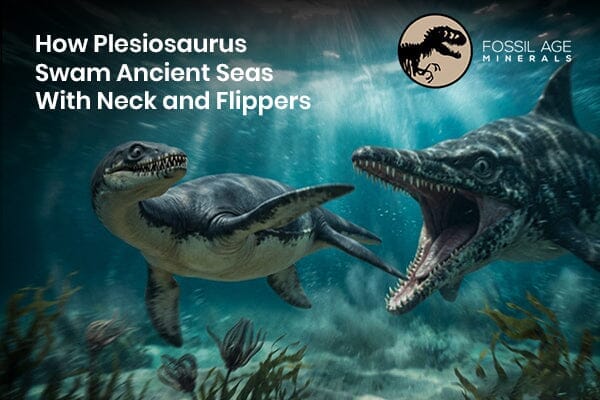
In the ancient oceans, many fascinating marine reptiles lived, quite extraordinary, appearing to flaunt their long necks and slender bodies in elegant strokes of underwater grace. With its paddle-like foreflippers and hind flippers, the Plesiosaur was a sleek, elegant swimmer that stalked its prey into the shadows, a mystery still to many scholars.
Understanding how this creature swam helps researchers reconstruct ancient marine ecosystems and better understand the evolutionary history of marine reptiles. All anatomical features had a particular role in helping it survive in vast, competitive seas.
A Body Built for Ocean Movement
Plesiosaurus was one marine reptile whose body differed widely from those of other marine reptiles. A broad body, an elongated neck, and paddle-shaped flippers confer a significant advantage in balancing during swimming, thereby enabling speed and control.
The main features are:
- A long, flexible neck
- Four strong flippers
- A short tail
- A compact, buoyant body
These features help it glide smoothly through water, eliminating the need for a sudden burst of speed. Instead of voracious running, it probably ambled peacefully through its environment using controlled swimming.
The Role of Flippers in Propulsion
Plesiosaur movement was characterized by the use of four flippers rather than two. Each flipper was essentially an aqua wing that provided lift and propulsion with every stroke.
Indeed, scientists hypothesize that the flippers moved in well-defined, synchronized patterns akin to those of present-day sea turtles, thereby providing a more streamlined and stable means of propulsion.
The flippers provided:
- Forward propulsion
- Steering control
- Balance in changing currents
- Ability to rise and dive smoothly
With the ability to walk effectively on land, this movement efficiency enabled long-distance travel without becoming exhausted, traits that were particularly advantageous for an oceanic lifestyle.
How the Long Neck Helped in Swimming and Hunting
One of the most recognizable features of the plesiosaurus is its long neck. Though seemingly rather unwieldy, this long neck would have served a major function in hunting and navigation.
Rather than rely on speed and chase, the plesiosaurus could keep a low profile in the water and extend its neck towards fish, or perhaps small marine animals. This would allow it to catch food without disturbing the water too much.
The benefits of this long neck were:
- Hunters would be able to make an extended reach
- Ability to scan surroundings without moving the body
- Increased balance while swimming
- Discretionary control of the approach to prey
This snugness and reachability could have meant not only distinct benefits to plesiosaurs in the ancient seas but also ensured a particular gracefulness of physical appearance.
Reconstructing Swimming Patterns Through Fossils
Plesiosaur movements are reconstructed by studying their remains and comparing them with those of modern marine animals. A detailed examination of the bones and joints suggests how these parts function during swimming.
A well-preserved plesiosaurus fossil offers insights into muscle insertion, limb range of motion, and body support. Fossils displaying complete limbs and trunk will enable researchers to assess how the animal’s appendages were used in movement and its placement in water.
Based on these studies, experts concluded that plesiosaurs may have had adaptations for rowing or flying. It was sufficiently powerful and efficient to pull it across grab distances while conserving power reserves.
Movement Through Ancient Oceans
Abundant predators and changing environmental conditions characterized the oceans of the Mesozoic Era. To survive, the plateosaurs swam in a balance of speed, stability, and endurance.
They could swim:
- With great facilities through open waters
- From one foraging area to another
- Away from larger marine predators
- With minimal expenditure over long distances
Its flippers and neck suggest a design for most of the life spent in swimming rather than on the seafloor; this incessant motion shaped its anatomy and ultimately molded its evolutionary trajectory.
As marine reptiles evolved different swimming methods over time, some retained the plesiosaurian mode to maximize underwater efficiency.
What Complete Remains Reveal Today
Plesiosaur movement is better understood through modern discoveries. This is due to advanced imaging and digital modeling, which allow scientists to observe the internal structure of fossils in greater detail than was previously possible.
Based on reconstructed plesiosaur skeletons, we can see how the neck, flippers, and torso functioned as a single unit. Densities in joints and bones provide flexibility in the sequences observed in motion and movements, and probably opportunistic speeds at the shallower levels.
Conclusion
Plesiosaurus was designed for swimming, with a body that bore the imprint of evolution over millions of years. It had a lengthy neck for the exact position of its feeding and four flippers for aiding it to sail smoothly across great speculative seas. These together contributed to the evolution of a marine reptile that adapted perfectly to the ocean.
Deep within the selections of real fossils for the avid geology enthusiast are genuine fossil samples, discernible as pieces of history proven by age. Whether they are students, collectors, or simply curious about life several million years ago, this collection brings them closer to the prehistoric world.
Start unearthing authentic fossil specimens today with Fossil Age Minerals and learn about the science, history, and mystery of ancient ocean life for yourself.


