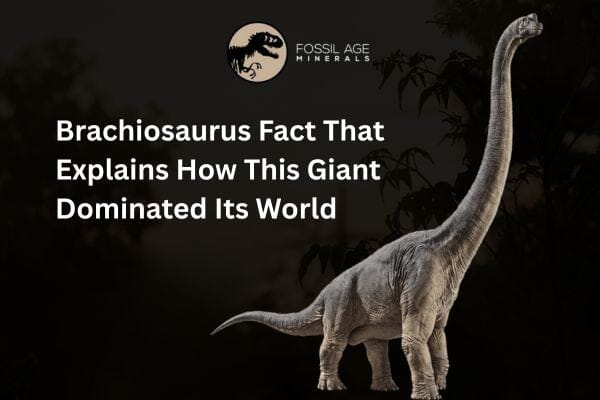
Looking at the list of terrestrial giants of their time, Brachiosaurus falls into the category of not only large but specifically designed animals. A fascinating Brachiosaurus fact is that it had forelimbs longer than its hind limbs, causing a slope in its posture. This strange-looking body was not meant for ornamental purposes. The shape enabled the beast to survive, and more so to excel, and, if possible, to outcompete its contemporaries amidst the dense vegetation found in ancient ecosystems.
To understand Brachiosaurus, you have to picture its world-and the silent combats being waged over foliage, rather than territory.
A Giant in a Forest of Competition
Imagine a Late Jurassic forest populated with tall conifers and cycads. Dozens of huge herbivores shared the same space, all dependent upon vegetation to survive the day. When your life hangs in the balance under such an arrangement, brawn is less important than access. Brachiosaurus did not compete in the common arena where their food disappeared almost as soon as it appeared.
This dinosaur lived above the fray, feeding on the reach for the top like few of its contemporaries could. It thus reduced the likelihood of soulier competition with the rest and brought the dinosaurs down to the ground.
Why Height Became Its Advantage
Brachiosaurus' height made everything possible for it. Such great lengths of neck and shoulders made Brachiosaurus capable of feeding much higher than anything else. This means less intra-herbivore competition and constant access to food.
The advantages encompassed:
-
A naturally upward-angled neck
-
Longer front limbs are trusted for vertical reach
-
A large, but stable, body perfect for slow, efficient movement
In such a manner, by feeding high up into the forest canopy, Brachiosaurus could stay in one place longer, reducing the need for changing places and conserving valuable energy.
The Science Behind Its Diet
It is easier to comprehend the effectiveness of the strategy when the factors behind the enormous body's growth have been lodged in a person’s mind. The prevailing feeding patterns of the brachiosaurus diet took into account three factors: the type and mode of vegetation growth, the animal's anatomy, and the need for energy.
A diet mainly composed of herbs supported by a high-stemmed carpet of conifers and gingko trees
-
Favoritism of fibrous foliages that are mostly above ground
-
Gobbles food several times a day so as to maintain size
-
Metabolism is fine-tuned to continuous grazing rather than to active hunt
This feeding pattern had nothing to do with variations. It was all about being devoid of fluctuations and span.
How Did It Eat Without Chewing?
Brachiosaurus was such a large animal that it swallowed its food without any chewing. The digestion process occurred inside its body, aided by the small stones, or gastroliths, it swallowed to grind tough vegetation in the stomach. This method is still seen in some modern birds and enabled Brachiosaurus to efficiently digest large amounts of food.
Thus, the food was transformed into slow, sustained energy expenditure rather than being chewed, bacterialized, digested, and utilized.
Lessons From a Long-Necked Giant
The Brachiosaurus teaches the significance of survival through adaptation. Instead of evolving weapons and speed, it adapted to keep away from conflict. It occupied a specific niche in feeding away from others, thereby avoiding competition within its ecosystem.
Its story helps scientists understand:
-
How large herbivores shaped ancient forests
-
The role of body structure in survival strategies
-
How ecosystems supported multiple massive species at once
How Fossils Preserve This Story Today
So, what did a brachiosaurus eat? How do we determine that? Fossils can include clear features of these new additions, such as wear on teeth and the remains of plants and bones, which help paleontologists build this picture. Fossil Age Minerals help bridge the gap between fossils in images and the real world, allowing collectors and enthusiasts to own authentic historical pieces.
Exploring actual fossils is not mere object ownership; instead, it plays a key role in the connection to the old tales carved in stone and fuels the curiosity that keeps Earth's remote past alive.


