
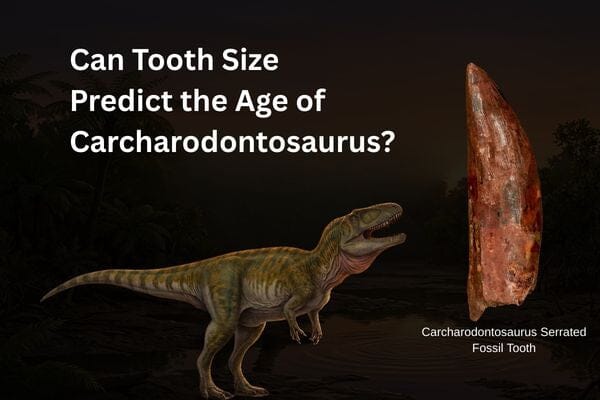
Palaeontologists often reconstruct a dinosaur's life from bits rather than complete skeletons. Teeth are the largest and most common remains of major carnivores, which raises the question of whether tooth size indicates age at death. This question is particularly pertinent to a gigantic carnivorous dinosaur with few complete skeletons to assess its full growth in natural settings.
Understanding the limits of what tooth size can tell us helps separate valid conclusions from mere conjecture.
The Role of Teeth in Dinosaur Studies
The teeth are among the hardest biological structures found in vertebrates. Their density enables them to survive events that destroy even bones nearly as hard, which is why they are often found at fossil sites. Big predators laying down their teeth throughout life; it follows that many of these were assembled separately in the fossil record over a single lifetime.
Since teeth are so abundant, they are often used to identify species and behaviour. Teeth themselves are just a small piece of the evidence that needs careful comparison rather than a quick conclusion.
How Do Teeth Develop in Large Theropod Dinosaurs?
Theropod dinosaurs had a unique way of growing teeth, unlike that of most humans and mammals. To put it simply, the old teeth would fall out as new teeth emerged behind them to take their place. The process occurred in a sequence spanning various ages and groups.
Many factors influence the size of teeth during the growth cycle:
-
Skull and jaw size
-
Growth rate
-
Position in the dental arcade
-
Upper jaw teeth compared with those of the lower jaw
-
Phenotypic variation between individuals
Tooth size thus reflects the jaw structure rather than an individual's age. A younger dinosaur jaw would create teeth equivalent in size to those of a smaller but older individual.
Why Size Alone Is an Unreliable Indicator
It may appear logical to associate older dinosaurs with larger teeth. However, such an assumption would never really hold. Teeth from different parts of the jaw usually differ significantly in length, thickness, and curvature.
Several factors make size-based findings weaken, according to:
-
The front teeth and back teeth differ in shape and proportion by nature
-
The timing of tooth replacement varies individually
-
The behavior of feeding can influence the wear pattern
-
Breakage or erosion can alter any original size.
Wear complicates it further. A severely worn tooth could suggest extensive usage without necessarily meaning the animal was old. The severe wear, in fact, may arise only because the tooth in question is one of the few more stressed locations during feeding. Without knowing the tooth position or angle due to wear, size-in—and by itself—tells us little about age.
Does a Larger Tooth Always Mean an Older Dinosaur?
Tooth size cannot be the only attribute considered. A large tooth can prove to belong to a growing animal with a heavy jaw, while a smaller tooth can belong to an adult dinosaur with a lighter skull.
Accordingly, paleontologists avoid single measurements; rather, they look for broader patterns across multiple specimens and compare sizes, shapes, and wear to sculpt a more accurate portrait for growth and maturation.
The Importance of Fossil Context
Teeth form substantial scientific evidence, but teeth endorsed in association with jaw parts or significant fragmentary evidence from cranial parts or well-located teeth in verifiable altered rock unit tend to be highly reliable evidence.
This is particularly true of Carcharodontosaurus fossils, which are often incomplete. By studying teeth in relation to their geological setting and associated remains, researchers can substantially increase their knowledge of variation within the species and ascertain whether the specimens were juvenile, subadult, or adult.
Should Collectors Use Tooth Size to Judge Age?
For those interested in collecting, the tooth's size should be taken as a hint rather than confirmation. A small tooth does not necessarily mean the dinosaur was young, whereas a slightly larger tooth does not automatically mean the dinosaur was fully grown or an adult. But it shows more promise for the former case than for the latter.
An educated collector will also consider shape, preservation, wear, and provenance. Hence, acquiring more background information on the subject will enhance the value of carcharodontosaurus teeth, showing them to be cleverly collected caricatures of palace life rather than mere measurements.
Conclusion
The size of the tooth does not entirely predict the age of Carcharodontosaurus. Accurate age determination in dinosaurs requires a carefully differentiated analysis of intrinsic peculiarities and the surrounding minerals. Age estimation in dinosaurs requires a sophisticated assessment of the structures, not a mere recognition.
Fossil Age Minerals makes that level of understanding accessible for theropod specimens that are well cataloged and supported by truthful narratives. His real interest is in seeing original fossils through replication, and with their best-selected piece, you can really learn about the science behind many discoveries.


