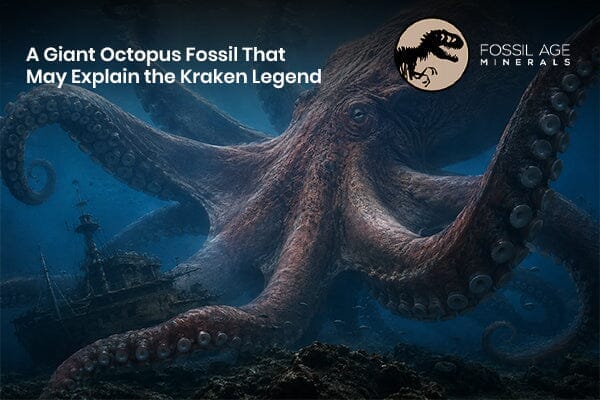
In a recent scientific discovery, a modern reorientation of the ancient myth of the Kraken, the sea creature, has been made. Over the centuries, sailors have dreamed of vast oceanic beasts with extended tentacles on the horizon, capable of grabbing ships and pulling them into the dark depths. Such myths were usually dismissed as exaggerations of legends or perhaps as fear of the unknown.
Recent discoveries of fossils imply that the stories about scary octopuses may be rooted in real-world evidence.
Researchers discovered that a colossal octopus-like creature roamed Late Cretaceous Earth approximately 100 million years ago. This finding is not only of its kind but also contributes to the first major challenge in understanding the oceans of those times.
What Exactly Did Scientists Find?
The key to the discovery lay in fossilized jaws (beaks), analyzed in real time with modern imaging techniques, revealing fascinating details about the beast's motions and body size.
-
Estimated length up to 60 feet
-
Time Period approximately: 100-72 million years ago
-
Type: Ancient Cephalopod (Octopus)
The fossilized specimen exhibited extensive wear and tear, suggesting that the predators ate prey with both shells and bones.
This change will lessen the previously accepted theory that large reptiles were the primary inhabitants of the ancient oceans.
Bigger Than Dinosaurs in the Ocean?
The most important thing about the recent find was its huge size. Giant octopuses could equal or even exceed the lengths of most sea reptiles.
The assumptions of the researchers about the giant octopuses:
-
Were among the apex predators of their era
-
Could have been competing with marine animals such as mosasaurs and plesiosaurs
-
Possessed strong beaks to crush bones
There are signs that they hunted large marine animals for food. This disproves the belief that the seas were dominated solely by vertebrates.
How Closely Does this Fit the Tale of the Kraken?
The Kraken, based on Norse legends, is usually portrayed as a massive, many-tentacled sea creature. Stories can embellish facts and do not always accurately depict actual creatures. According to the study, even when greatly overstated, these tales appear to hold a grain of truth regarding real animals.
An intelligent, fully or partly tentacled giant predator could match Nanaimoteuthis haggarti, which is close to the descriptions in the general mind's eye.
Though this animal might not have sunk ships, it probably:
-
Dominates its habitat
-
Had complicated behaviors
-
Had sophisticated hunting techniques
It is the relationship between myth and science that makes this discovery particularly exciting.
A Fresh Perspective on Ancient Oceans
In the history of all discussions about ancient oceans, what comes to mind are marine reptiles- the likes of ichthyosaurs and mosasaurs. Here, a sea predator with a slightly different outline is presented: it has no backbone, yet is formidable.
These revelations stem from an understanding of:
-
Marine creatures are more diverse than previously thought
-
Invertebrates can be huge
-
Natural selection produced many types of top predators
It indicates a transition from viewing a single species as dominant to understanding a more complicated environmental system.
What Makes This Discovery So Important?
More than just discovering a new species, this finding alters current assumptions concerning evolution, competition, and survival within ancient ecosystems.
Some important takeaways from this finding include:
-
Dominant predators did not always possess a skeletal structure
-
Survival was possibly aided by intelligence
-
The balance of ancient oceans was more even than expected
This finding also demonstrates the power of contemporary technology to reinterpret past fossil records.
Conclusion: When Myth Meets Fossil Evidence
The idea of a Kraken existing in reality was once seen as very unlikely, yet it seems that scientific discovery and legend are now coming together more closely.
What was once thought to be a myth is now supported by fossil discoveries, revealing an ocean more mysterious and complex than previously imagined.
For those interested in exploring such fascinating pieces of natural history, Fossil Age Minerals offers authentic fossils and educational insights that help connect these discoveries to the real world. Their collection offers a deeper understanding of ancient life, turning curiosity into a tangible experience.
If you're eager to explore fascinating natural history relics, Fossil Age Minerals provides genuine fossils along with educational details that connect these discoveries to everyday knowledge. The collection gives one the deepest understanding of ancient life and makes it a more concrete experience.


