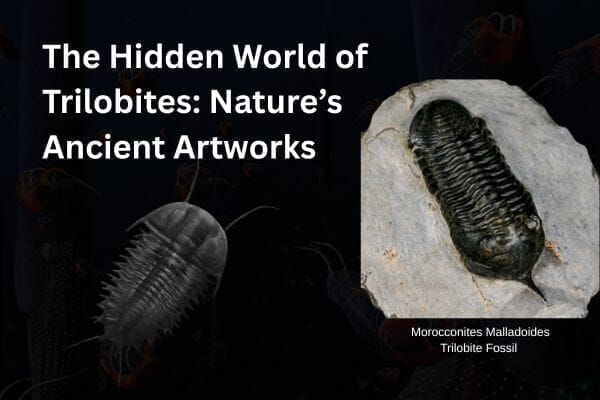
Trilobites are some of the oldest types of arthropods. They showed up more than 521 million years ago in the Cambrian period. They lived in the oceans for about 270 million years. In the end, they all died out at the close of the Permian.
-
Evolutionary importance: Trilobites were some of the first animals that had hard exoskeletons and bodies with several segments.
-
Range: Scientists have found over 20,000 kinds of trilobites. These creatures could be very small, less than 1 cm, or big, over 70 cm long.
-
Body breakthrough: A trilobite’s body was split into three main sections—the head (cephalon), the middle (thorax), and the tail (pygidium). This helped them bend and stay safe.
People who are interested and people who study often look for trilobite fossil for sale. Each one you find lets you see how these ancient animals changed over time.
How Did Trilobites Live and Adapt
-
Trilobites lived in many parts of the sea, from close to shore to far below on the ocean floor.
-
A lot of them had eyes with many parts made from a mineral called calcite. This helped them see well so they could spot other animals that might come after them, or look for what they could eat.
-
Their hard bodies had parts and spikes that helped them move and kept them safe.
-
Most of them crawled near the bottom, but some could swim a bit to get away from danger.
-
When they shed their old skin to get bigger, they left plenty of fossils for people studying old life to find.
What Can Trilobite Fossils Tell Us About Ancient Oceans
Trilobite fossils are very important for understanding Earth’s old ocean life. When they are found in certain rock layers, scientists can learn about how deep the water was, what the ground was made of, and what the weather was like back then. Marks from bites, rolled-up fossils, and traces in rocks show how animals hunted and escaped. By looking at the chemicals in the rocks around them, people also get to know what was in the water many years ago.
When paleontologists look at these fossils, they can get a clear idea of life during the Cambrian and Paleozoic times.
The Anatomy of Trilobites: A Detailed Look
-
Cephalon (head): The head had sensory organs and eyes that were made up of many small parts.
-
Thorax (body): The body had several joined parts, so it could move easily and roll up to stay safe.
-
Pygidium (tail): The tail often had parts that had grown together. Its shape was different in each kind.
-
Spines and ornamentation: These helped keep the animal safe and helped it stay steady in water.
The many differences in their body parts shows how they could live in lots of places and find ways to stay alive.
How Are Trilobites Used in Scientific Research
Trilobites are not just old fossils. They help us learn about how the earth has changed over time.
-
Biostratigraphy: Trilobites help scientists tell how old rock layers are by looking at which types are found in each layer.
-
Evolutionary studies: Show changes in shape and form in early arthropods over time.
-
Environmental reconstruction: Help us know more about old ocean conditions and how the ecosystem worked back then.
-
Education: People in museums and classrooms use trilobites to teach about the life that lived in the sea long ago.
Collectors often put trilobites next to fossils for sale like ammonites or brachiopods. This helps people get a better idea of what life was like in ancient times.
Preserving and Studying Trilobites Today
Keeping trilobites safe helps them keep their use for science and learning. You need to handle them with care so they do not break. Also, writing down details like their kind, where you find them, and the layer they come from helps with good research. When you put these fossils on stands or in strong cases, you can both study them and enjoy how they look. Fossil Age Minerals has a chosen set of real pieces, like top-level Fossil Age Minerals, so both collectors and teachers can look into Earth’s old times and share what they find with other people.
Conclusion
Trilobites help us see how early sea life started, acted, and lived. Fossil Age Minerals lets you get real trilobite samples and some other hard-to-find fossils. This helps people who collect fossils and those who teach about them. Their team picks each piece with care. This way, what you get is always good for learning, showing off, or finding out more about the old oceans on Earth.
Look at what they have today so you can feel the amazement and see how special these old creatures are.


