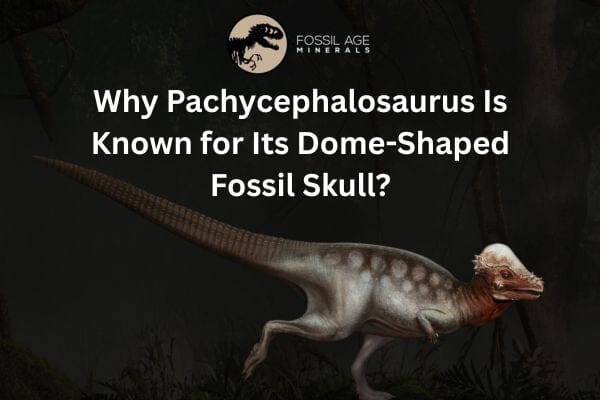
Pachycephalosaurus is one of the few dinosaurs that nearly anyone on the street would recognize, mainly because of the huge dome-shaped head. The herbivorous dinosaur lived during the Cretaceous period and soon attracted the attention of scientists and enthusiasts because of its distinctive anatomy and the thick layer surrounding its skull.
The domed skull of the dinosaur is not just for aesthetics but also has significant functional consequences for the animal's interaction with the environment. It's clear from fossil evidence that the development of one of the most distinctive skull architectures in the dinosaur world was an evolutionary achievement of the animal.
What Made Pachycephalosaurus Physically Unique?
Pachycephalosaurus, with its sturdy hind legs, small body, and extreme skull density, occupied a niche within dinosaur diversity. While some species, such as horned and armored dinosaurs, bear spikes, others, by contrast, have plates; both groups can develop a solid bone dome on their heads that may be up to several inches thick.
Salient attributes included
-
A rounded skull roof of solid bone
-
A few bony knobs are scattered over the head
-
Primarily bipedal stance
-
The body weight is lower than the volume of its skull.
From its various physical attributes, Pachycephalosaorus was unique and memorable. Even with just its skull configuration, this dinosaur distinguishes itself.
The Structure of Its Dome-Shaped Skull
The dome-like skull was not simple armor but was layered, reinforced, and shaped into a strong yet slightly curved protective structure. These allowed the skull to absorb force without compromising stability.
Inside the dome, the hard bone was for strength, whilst the outer surface was smooth and rounded. The skull's architecture implies that it was designed for toughness and to protect the dinosaur against physical stress and environment challenges.
Thus, this distinctive construction explains why the skull of Pachycephalosaurus is among the most widely investigated features in dinosaur paleontology.
Why Scientists Study the Thick Skull So Closely
Researchers continue to investigate the reasons for the Pachycephalosaurus skull. A major theory is that the skull may have been used for head-butting during competition and in other interactions with the environment.
Possible functions include:
-
Establishing dominance within groups
-
Competing for mates
-
Visual display and species recognition
Some scientists argue that the dome armour was primarily defensive rather than offensive. Meanwhile, the debate continues, and with every new fossil find about possible interactions or living patterns, it is expanded.
Fossil Discoveries That Revealed Its Secrets
Most Pachycephalosaurus fossils have been found in North America, where evidence of prehistoric life is preserved in late Cretaceous formations. The skull dome is usually the part of the skeleton that is in the hardest condition.
A well-preserved Pachycephalosaurus skull provides highly informative data on cranial morphology and development, revealing species-specific growth patterns and anatomy. The mount and basioccipital must meaningfully contribute to an understanding of the animal's head and its evolution over time.
Perfect interpretability should also follow from any such discovery toward a feature that defines both the species and the environment.
Why Dome Fossils Fascinate Collectors
Pachycephalosaurus skull domes are fascinating features. They are very rare, important from scientific perspectives, and are therefore collectibles as well as useful in educational settings.
This is what collectors see in the value of these fossils:
-
A direct connection to prehistoric life
-
Distinctive appearance compared to other fossils
-
Educational and display significance
-
Limited availability in the fossil market
The very smallest piece of a skull dome can fetch a big value that comes through an entirely comprehensive pattern of rarity, workability, and general beauty.
What These Fossils Teach Us About Dinosaur Behavior
Pachycephalosaurus fossils explain how these creatures evolved and how these dinosaurs behaved. Scientists can determine whether these creatures interacted with one another and could survive in the environment by observing skull thickness, bone texture, and exit variations.
Modern technology, such as CT scanning and 3D imaging, allows scientists to investigate fossils non-invasively, unveiling their internal structure and growth stages and offering new perspectives on the life of this dome-headed dinosaur.
With all specimens, another small piece of the puzzle will allow scientists and dinosaur enthusiasts alike to see how complex prehistory actually was.
Start Your Fossil Collecting Journey
The impressive dome-shaped skull of Pachycephalosaurus is arguably the most interesting aspect of dinosaur research, indicating a history of adaptation spanning millions of years and a pivotal moment in evolution when a particular species evolved peculiar survival strategies and later interactions with its companions.
Collectors seeking genuine prehistoric specimens can obtain an authentic Pachycephalosaurus fossil for sale from a reliable source or an expert in its curation.
Fossil Age Minerals helps enthusiasts and collectors explore carefully sourced fossils while providing education that further dignifies each natural history specimen.


