
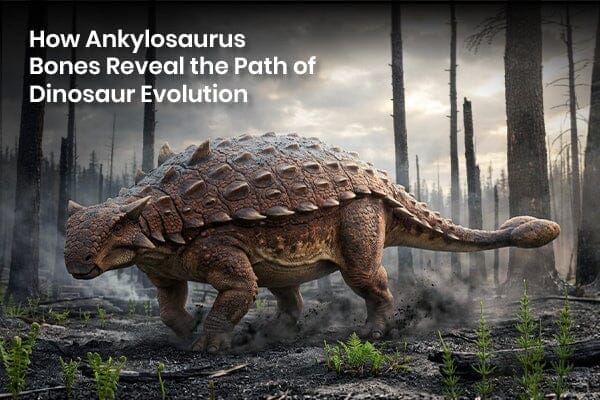
Ankylosaur bone anatomy provides remarkable insights into how different dinosaur species lived, adapted, and evolved over millions of years. These fossils may be considered in a broader context than a single species. These structures provide researchers with basic insights into how dinosaurs evolved, adapted, and coexisted in Late Cretaceous environments.
A detailed analysis of skeletal remains helps paleontologists decode evolutionary patterns not only in ankylosaurs but also in many other plant-eating dinosaurs. Each finding becomes another piece in the pre-history picture.
A Dinosaur Built for Survival
The natural history of Ankylosaurus bones suggests that the structure was used for defensive purposes. This creature was designed for defense rather than speed. Plates of thick bone, called osteoderms, were embedded in the skin to form a protective shield covering the back and sides.
This helps scientists understand:
- How some dinosaurs developed physical defences to ward off intruders
- Why was armour able to develop into a successful survival mechanism
- How the body structure changed in different environments
The heavy, unbreakable skeleton suggests that ankylosaurs lived in environments where predation was constant. Their bones challenge a long evolutionary history of protection and endurance.
Tracing Evolution Through Bone Structure
The practice of scientists and paleontologists involves comparing collections of Ankylosaurus fossils with those of similar dinosaurs from the same time period. The aim is to track changes over the period of their evolution.
This comparison is divided into distinctly separate types of significant transformations dependent on:
- Gradual expansion of the thickness of the body armor.
- Structural changes to accommodate weight-bearing elongation in each successive species.
- Development of tail clubs as the defining form of defence.
The transitions were not instantaneous but rather characterized by evolutionary unfolding. Fossil bones are direct evidence of how species respond to environmental changes such as predation, climatic shifts, and changes in food availability. Such transitions necessitate mapping the entire tree of life of dinosaurs and examining relationships among herbivorous subgroups.
What Teeth Reveal About Evolution
Bones form the foundation of evolutionary study, although teeth offer additional information about how ankylosaurids ate and lived. The evolution of ankylosaur tooth demonstrates that these dinosaurs were terrestrial herbivores with an advanced masticatory apparatus.
Unlike the sharp, pointed teeth of carnivores, ankylosaurs had teeth that were:
- Leaf-shaped
- Small and ridged
- Designed for grinding vegetation
These traits suggest a primarily low-growing vegetation diet, such as that of ferns and shrubs. The herbivorous dinosaurs developed dental patterns reflecting distinct dietary habits. Thus, an examination of these teeth provides information on evolutionary changes in plant-eating dinosaurs throughout the Cretaceous period.
The available bone and teeth evidence deepen our understanding of how ankylosaurs entered the biome.
Connecting Ankylosaurs to Other Dinosaurs
Ankylosaurus did not evolve in a vacuum. Its bone features are similar to those of other armoured dinosaurs, namely nodosaurs. The shared traits preserved in fossils allow scientists to trace evolution.
For instance:
- The variation correspondences implied patterns derived from a common stock.
- Different structures in the tail arose through distinct evolutionary pathways.
- Skull shapes, accordingly, reflect dietary adaptations.
Ultimately, comparative analyses showed that the theropod dinosaur's environment was light, leading to continual adaptations and modifications of its spine.
The most advanced of all the armored dinosaurs, known as 'Ankylosaurus,' provides a picture of nearly the pinnacle of defensive evolution.
What Fossilized Bones Tell Us About Ancient Ecosystems
Fossilized ankylosaurus bones allow for inference from information about the habitats the dinosaur had lived in. In their formation, the bones also indicated heavy-built bodies that had managed to withstand any intended function.
From these, the following inferences are possible:
- Presence of large predators that required defensive adaptations
- Vegetation-rich habitats supporting herbivorous diets
- Stable ecosystems where large, armoured dinosaurs could thrive
Unlike fossils, each discovery narrows the overall picture of prehistoric organisms and suggests the specific evolutionary pressures that could account for it.
Why Ankylosaurus Still Matters Today
The study of ankylosaur anatomy continues to exert a cosmetic influence on modern paleontology, supporting technologically advanced reconstructions of development and corresponding biological responses in bone structures. These advances could all further help in:
- Reconstructing movements and postures of ankylosaurs
- Studying the growth patterns of ankylosaurs
- Identifying subtle gaps in ankylosaur evolution.
With further examination of the specimens, Ankylosaurus stands as a keystone species for understanding the evolution of specialized defenses and the adaptation of these dinosaurs to their environment.
Conclusion
Research on Ankylosaurus anatomy greatly sheds light on the world as it was millions of years ago. From time to time, discoveries of ankylosaur remains inform our understanding of evolutionary affiliations across diverse paleoecological environments. They advance our understanding and benefit from science; prompt rethinking of Earth's age-old past by several thousand years.
For anyone who is a real enthusiast of prehistoric artifacts and ancient life, a few genuine fossils from Fossil Age Minerals that connect them to history are essential.
Let your dream world live through this enclosed collection, made from historical life as told by the fossils awaiting challenge.


