
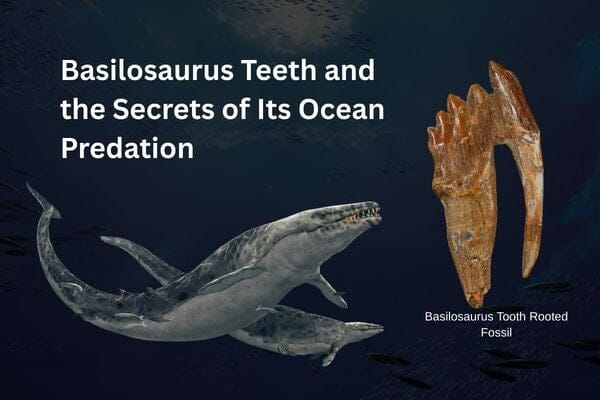
Millions of years ago, in the ancient oceans, Basilosaurus was the top predator and second largest marine mammal to date. Described in the Late Eocene Epoch, this ancient whale had a long, serpentine body and fierce teeth for catching prey.
Sharp, serrated teeth were the ultimate tool for this warm-weather Cretacean family member's survival against armored predatory fish and smaller marine animals. Biologists can study the teeth, which would provide valuable insights into how this ancient hunter hunted and consumed its prey.
The Structure of Basilosaurus Teeth
The teeth of Basilosaurus exhibited peculiar characteristics that may also indicate a prey-oriented functional adaptation. These teeth, which deviated from the baleen of today's whales, once bore down dorsally and were serrated with robust, rigid teeth on clamps.
The following are among the notable features of Basilosaurus teeth:
-
Conical, long form for easy manipulation of the prey
-
Sharp edging at the cusps for cutting of flesh
-
Enamel deep inside for the generation of a sharp-edged tooth
-
Locking of the tooth into the jaw
Certain traits have evolved for traveling long distances and for grasping slippery prey underwater. With serrated cutting edges and robust supporting roots, the teeth were designed not only to tear meat but also to do so in a dynamic hydraulic environment.
How Strong Was Its Bite?
It is hard to measure accurate force bites. However, fossil evidence shows that Basilosaurus had a large, powerful jaw for attacking large prey. Because of the head's design, the strong jaw muscles worked in perfect unity with its teeth.
Researchers suggest Basilosaurus may have primarily hunted the following:
-
Large fish
-
Smaller marine mammals
-
In shallow water, reptiles
The strength in its teeth allowed it to pierce and hold rather than crush its prey. Here, the hunting method involved seizing and tearing rather than grinding, which aligns with the tooth morphology observed in the fossils.
Adaptations for Life as a Marine Predator
The effectiveness of Basilosaurus teeth wasn’t only based on their sharpness; their placement and spacing also played a part in determining hunting success. These teeth were placed to form an effective grip, allowing the animal to catch up with its prey even at high speed.
These adaptations offered several advantages:
-
Improved ability to prey on fast-moving animals
-
Significant reduction of escape chances by prey
-
Effective tearing of meat pieces for consumption
These characteristics made the Basilosaurus an adaptable and strong predator in the ancient ecosystem. Its teeth were indispensable tools for the animal to best serve it in competing in the hostile ancient oceans.
What Fossil Evidence Reveals
Fossil discoveries have enhanced our understanding of Basilosaurus's feeding. These fossils, especially the well-preserved specimen of a Basilosaurus, show parts of the jaw and teeth worn down by feeding.
Helping scientists to understand:
-
Tooth shape and growth patterns
-
Jaw alignment and bite function
-
Possible diet and feeding behavior
Wear patterns on Basilosaurus's teeth suggest repeated use against tough prey, indicating that the creature used its tooth power for survival throughout its life. Each new fossil found adds even more detail to the picture of how this ancient whale hunted thousands of years ago.
Why These Teeth Continue to Fascinate Collectors
The most valuable aspect of Basilosaurus teeth is that they attract both collectors and educators who want to study their unique curved shape, which serves as a perfect representation of anatomical design, and their connection to the development of early whale species.
A collector cherishes the fossils for:
-
Their link to prehistoric marine life
-
Unique structure compared to other fossils
-
Educational display value
-
Connection to early whale evolution
The ancient oceans of prehistoric times are embodied in these fossils, which tell the story of life that has both existed and disappeared throughout history.
The Story These Fossils Continue to Tell
The teeth of Basilosaurus served as essential tools, enabling the animal to hunt successfully in aquatic environments. The strength and shape, combined with the arrangement of its teeth, allowed this extinct whale to hunt and consume its prey while it swam through the ancient ocean waters. The teeth have provided significant insights into essential elements that enabled Basilosaurus to survive and evolve throughout its evolutionary history.
Genuine antique specimens will become available to you if your interest extends to authentic Basilosaurus teeth, which are currently for sale. Fossil Age Minerals provides collectors, students, and enthusiasts with carefully selected fossils and educational materials that enable them to study the complete field of natural history.


