
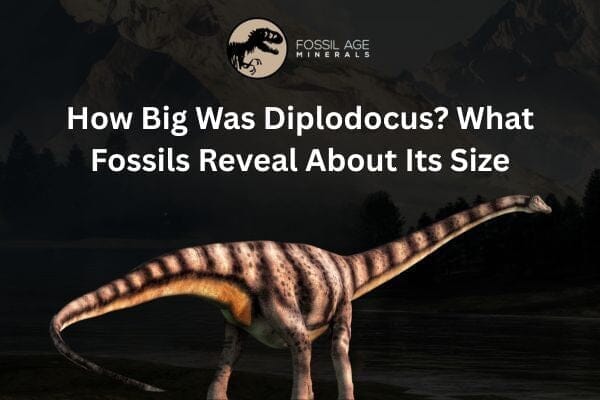
The name Diplodocus instantly evokes images of a long-necked, long-tailed giant roaming prehistoric landscapes. Artistic impressions cannot match fossil discoveries, which provide scientific evidence of a dinosaur's actual size. Paleontologists used skeletal remains to reconstruct the dinosaur's size, movement, and growth patterns. The research results show that the animal was not only large but also developed into a unique Jurassic period species.
Researchers use Diplodocus size measurements to investigate ancient ecosystem dynamics, dinosaur dietary patterns, and the evolutionary processes that produced the Earth's longest terrestrial dinosaur species.
Inside the Massive Frame of Diplodocus
The most noticeable feature of Diplodocus stems from its remarkable body length. The dinosaurs constructed their bodies to attain optimal reach through their ability to move flexibly. Fossil evidence suggests:
-
Complete measurement extends from 85 feet to 90 feet
-
Height reaches approximately 15 feet at its shoulder height
-
Neck extends to a length of about 25 feet
-
The tail length extends beyond 45 feet
Diplodocus had a body weight of 12-16 tons. The creature moved through its territory more efficiently because its lightweight body allowed it to travel while searching for food.
How Do Scientists Measure a Dinosaur That No Longer Exists?
Scientists conduct extensive research to identify the body measurements of extinct animal species. Paleontologists study preserved bones to match them with complete skeletons of related species.
The researchers use the following methods to examine the study subjects:
-
Measuring vertebrae and limb bones
-
Studying joint alignment and posture
-
Analyzing bone density and muscle attachment points
-
Creating scaled skeletal reconstructions
These techniques help researchers develop accurate estimates from physical evidence, thereby reducing reliance on unproven information. Improved fossil discoveries over time have enabled scientists to obtain more accurate measurements, resulting in improved reconstructions.
A Skeleton Designed for Balance and Reach
The skeletal structure of Diplodocus was built for length and stability. Its long neck allowed it to reach vegetation at varying heights, while its extended tail acted as a counterbalance.
Key skeletal features included:
-
Lightweight skull suited for stripping leaves
-
Hollow vertebrae that reduced overall weight
-
The limb bones are strong yet flexible, enabling the creature to walk without losing its balance.
Diplodocus achieved remarkable efficiency throughout its body because its design combined strong skeletal elements with lightweight components, enabling it to traverse extensive feeding areas without significant fatigue.
What Can a Diplodocus Fossil Reveal About Its Growth?
The Diplodocus fossil provides scientists with information about the dinosaur's entire life cycle. Younger specimens show shorter proportions, while adult fossils reveal dramatic elongation as maturity was reached.
Scientists have determined from these discoveries that:
-
The early years of life were marked by rapid growth.
-
Bones developed dense internal structures for support
-
Final body size took many years to achieve
The gradual growth of Diplodocus enabled the species to adapt to environmental changes and survive periods of food scarcity, allowing it to become the dominant species in prehistoric ecosystems.
Comparing Diplodocus to Other Giant Dinosaurs
The Diplodocus species does not achieve the highest weight among sauropods, but its body length remains almost unmatched. Diplodocus shows a slimmer body shape, which enables it to achieve greater length than Brachiosaurus and Apatosaurus.
The Diplodocus could reach food sources that other herbivores could not access because of its extensive reach. The species used this advantage throughout its existence to decrease competition with other species.
How Fossils Help Create Accurate Visual Reconstructions
Scientific research produces an accurate Diplodocus picture by combining bone-structure mapping with detailed analysis of animal posture and muscle development.
The visual models enable researchers to study:
-
Study feeding angles and movement patterns
-
Analyze skeletal stress points
-
Understand habitat interaction
The process transforms ancient bones into active representations of living animals, providing a clear view of prehistoric times.
Tracing Ancient Giants Through Authentic Fossil Discovery
The gigantic dimensions of Diplodocus provide scientists with measurement data and reveal how the species evolved and adapted to its environment, and how ancient ecosystems functioned. The fossil fragments provide additional evidence that the massive creature thrived millions of years ago.
Fossil Age Minerals allows collectors, educators, and enthusiasts to experience key events in Earth's history. Their fossil collections offer a substantial opportunity for people who want to witness the ancient scale of life and its remarkable qualities, as they connect to the distant past.


