


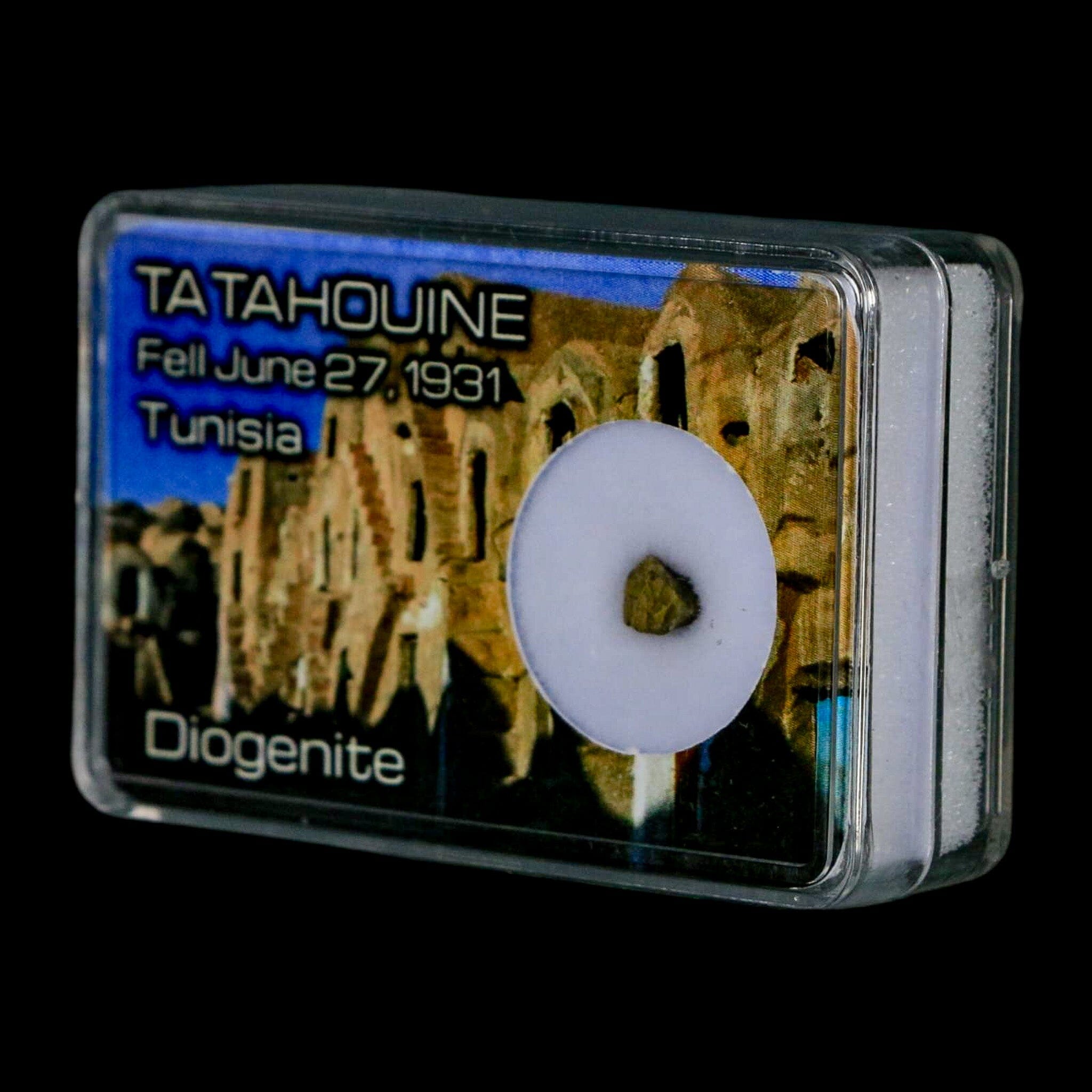


Description
Location: Tunisia
Weight: 0.4 Ounces (Display)
Dimensions: 2.3 Inches Long, 1.5 Inches Wide, 0.6 Inches Thick (Display)
Comes with a Free Display Case.
The item pictured is the one you will receive.
The Tatahouine Diogenite is an achondrite meteorite that fell on June 24, 1931, offering compelling evidence of planetary differentiation processes. This specimen is thought to derive from asteroid 4 Vesta, the asteroid belt's second-largest body, making it invaluable for understanding early solar system dynamics. Composed predominantly of orthopyroxene—an iron and magnesium silicate mineral—the meteorite exhibits the dense, dark appearance characteristic of its class. Its coarse-grained crystalline structure reflects protracted cooling within a parent body, enabling substantial crystal development. The mineralogy may include olivine, plagioclase feldspar, and metallic inclusions, with compositional variations reflecting distinct thermal and chemical histories. Cumulate textures in certain sections indicate crystal settling from magmatic conditions. This authenticated specimen provides direct access to extraterrestrial material and serves as a tangible record of planetary-scale geological processes that shaped our solar system's earliest epochs.
The formation of diogenites is closely linked to the geological history of Vesta. It is hypothesized that these meteorites formed from differentiated basaltic magma on Vesta's surface. As Vesta cooled, heavier minerals like orthopyroxene crystallized first and settled towards the bottom of magma chambers. Over time, impacts on Vesta could have excavated these materials and ejected them into space, where they eventually fell to Earth as meteorites.
The Tatahouine Diogenite specimen exemplifies the HED meteorite group, a classification encompassing howardites, eucrites, and diogenites—all believed to originate from asteroid 4 Vesta. This meteorite, which fell on June 24, 1931, serves as a critical research tool for deciphering planetary differentiation mechanisms and density-driven stratification within celestial bodies. Diogenites occupy a distinct position within this framework, distinguished by their mineralogical and chemical signatures from their HED counterparts. While eucrites represent basaltic material from Vesta's crust and howardites constitute mixed assemblages of both rock types, diogenites preserve evidence of deeper crustal or mantle processes. Analysis of such specimens illuminates the thermal and chemical evolution of differentiated asteroids and provides a comparative context for understanding planetary-scale geological development throughout the solar system. This authenticated sample offers researchers and collectors direct access to material that fundamentally informs our comprehension of planetary formation and early solar system conditions.