
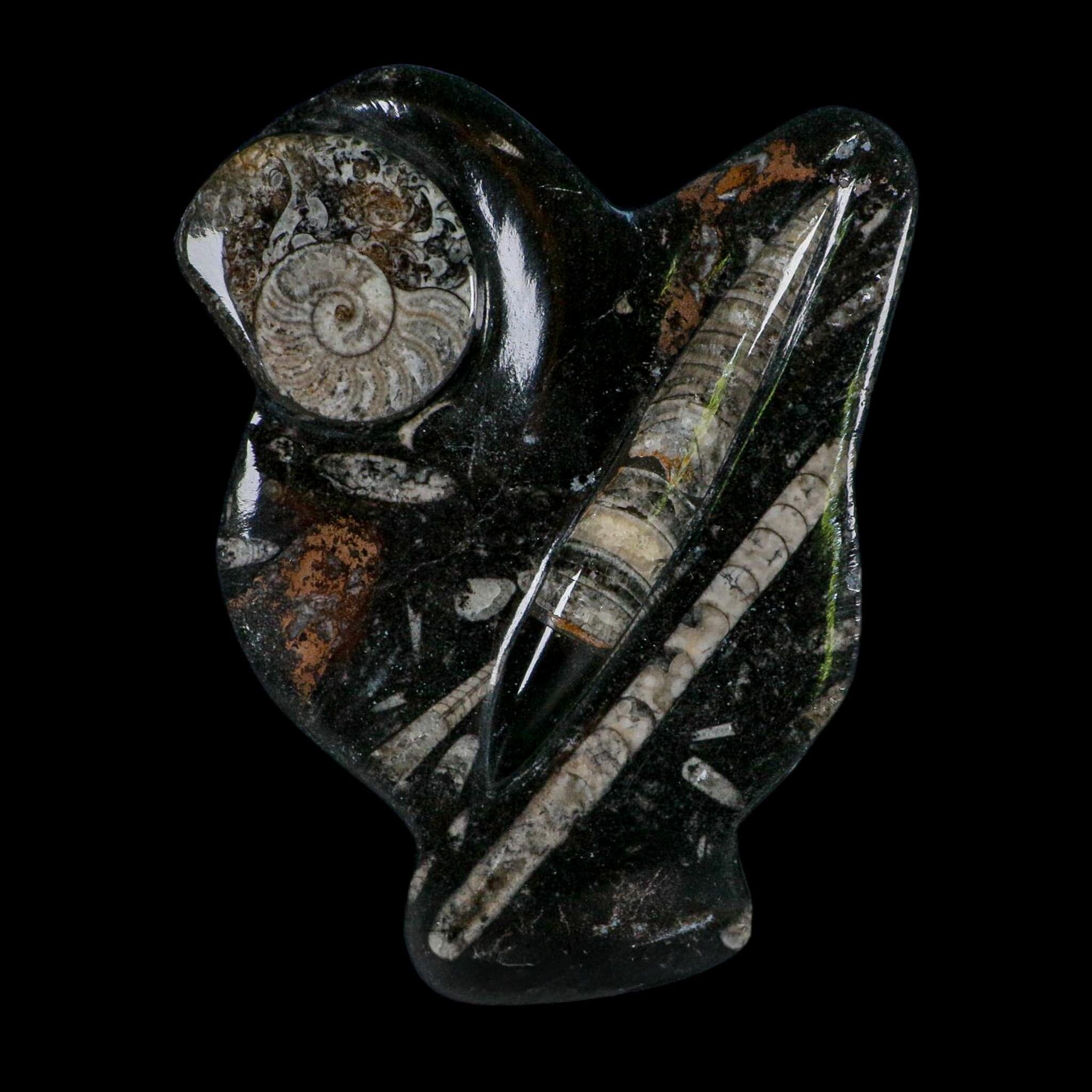
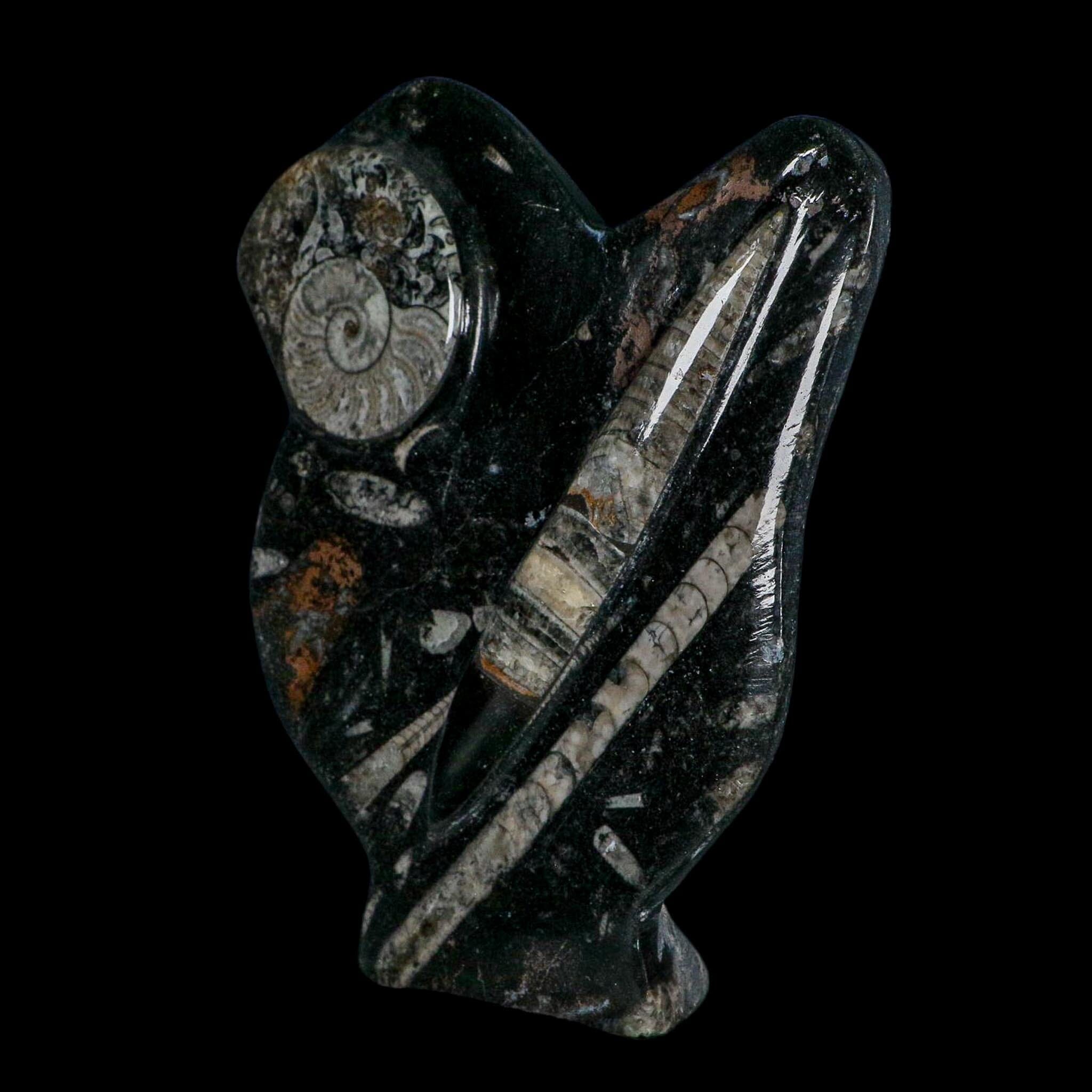
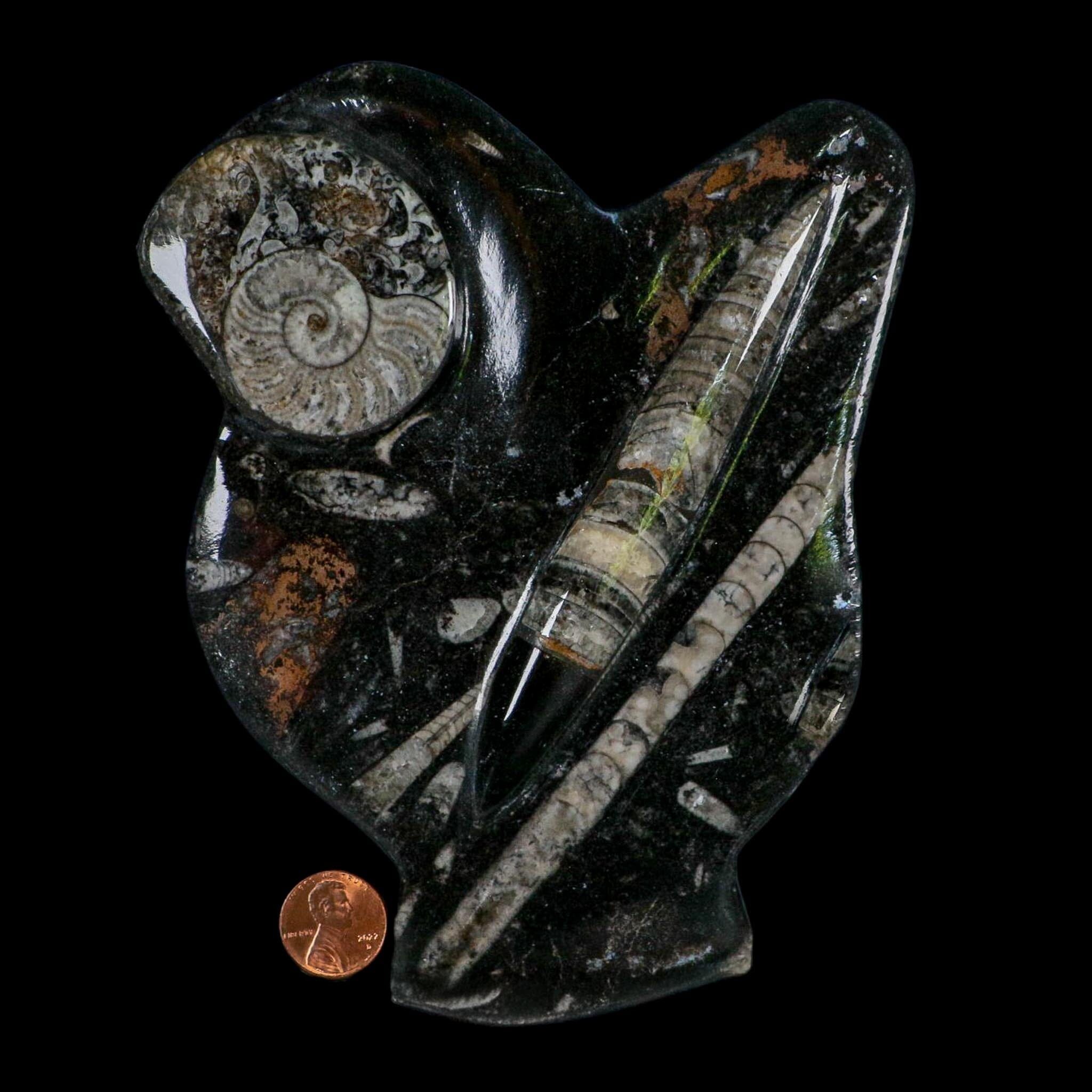
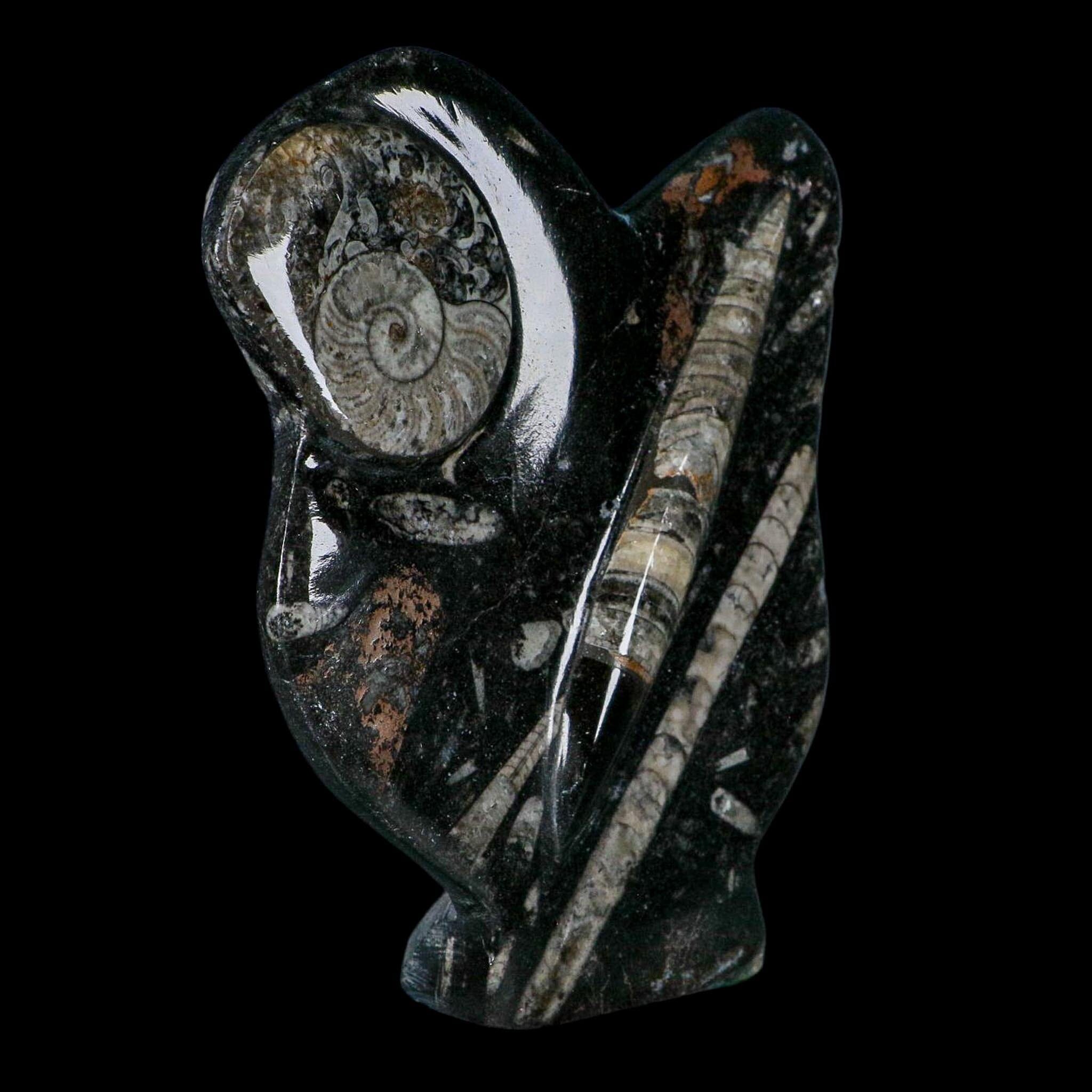
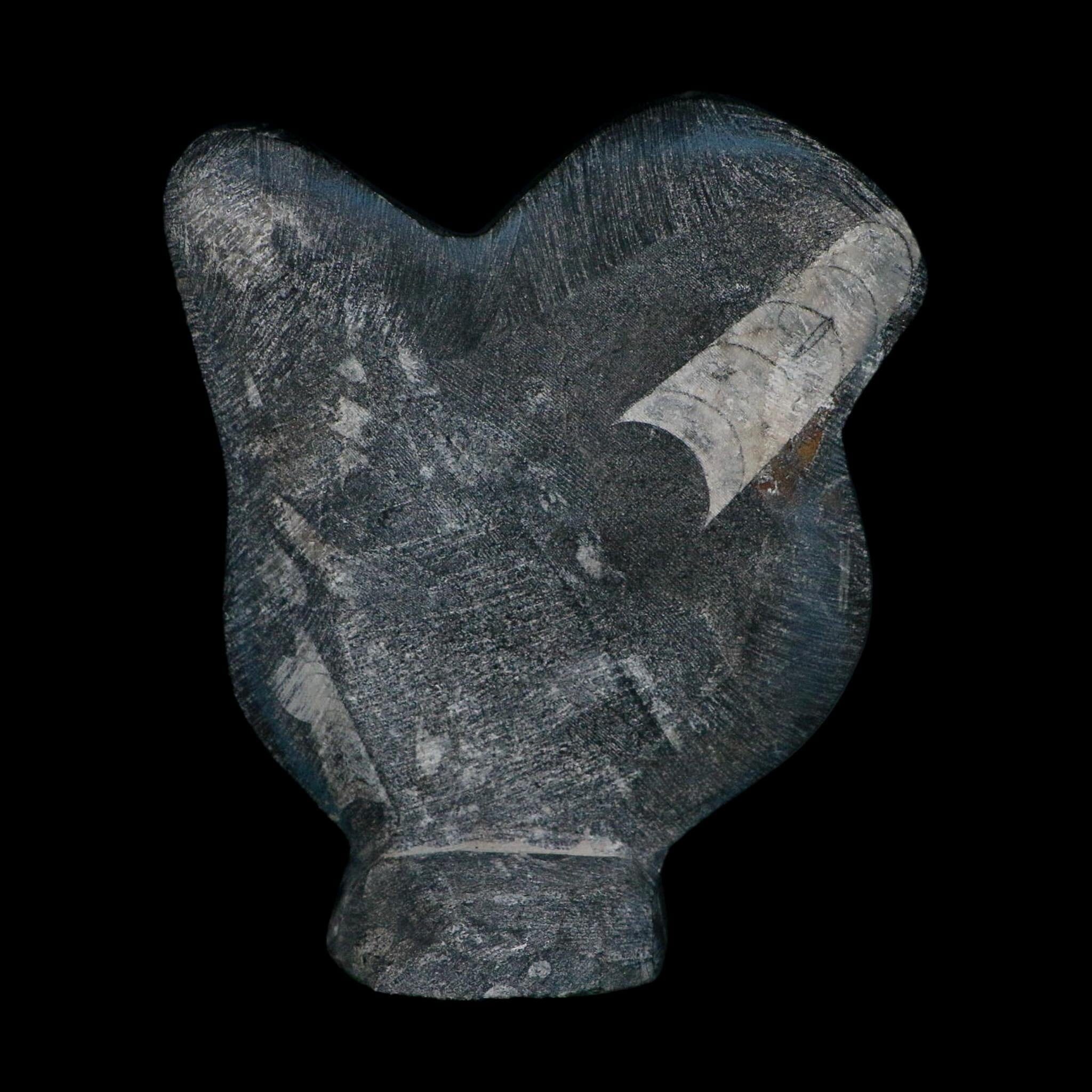


Description
Location: Erfoud (Anti-Atlas), Morocco
Weight: 1 Pound 6.1 Ounces
Dimensions: 6.2 Inches Long, 5.2 Inches Wide, 1.6 Inches Thick (Matrix)
Comes with a Certificate of Authenticity.
The item pictured is the one you will receive.
Devonian Age, 370 million years old.
Goniatite Ammonite and Orthoceras
Ammonoids were marine creatures that thrived from the Devonian to the Cretaceous periods. Their name comes from the distinctive "ram's horn" shape of their shells, inspired by the Egyptian god Amun, who was depicted with ram’s horns. Although they look similar to modern Nautiloids, their closest living relatives are likely octopuses, squid, and cuttlefish. Their shells were divided into chambers by walls called septa, and the connection of these septa to the shell’s exterior formed suture patterns important for identifying different Ammonoid species. The early Goniatites feature a "Goniatitic" zigzag pattern of smooth lobes and saddles, while later Ammonites display more detailed fern-like sutures.
Orthoceras fossils from Morocco are among the most iconic and visually striking marine relics of the Paleozoic Era. These extinct, straight-shelled cephalopods are ancient evolutionary relatives of modern squid, octopuses, and the Chambered Nautilus. While orthocone nautiloids are found globally, specimens quarried from the Tafilalt region near Erfoud and Rissani in southern Morocco are world-famous for their dramatic aesthetic contrast: bright white or silvery crystalline calcite shells suspended within a dense, charcoal-grey to jet-black limestone matrix (commercially referred to as Moroccan black marble).
Paleobiology & Fossilization in the Anti-Atlas
Roughly 400 million years ago, during the Silurian and Devonian periods, what is now the arid Sahara Desert of Morocco was submerged beneath a warm, shallow Paleozoic ocean. Millions of these active, predatory cephalopods patrolled the ancient water column, feeding on primitive crustaceans, trilobites, and early marine life.
When these creatures died, their elongated shells sank to the oxygen-depleted seafloor, where they were rapidly buried by fine carbonate mud and sediment. Over hundreds of millions of years, the organic shell material was gradually dissolved and replaced by mineral-rich groundwater precipitating crystalline calcite. At the same time, immense geological pressure compacted the surrounding nutrient-rich sea mud into the hard, fossil-dense limestone found across the Anti-Atlas mountains today.
Anatomy & Diagnostic Features
-
Orthoconic Shell & Camerae: Unlike their coiled cousins, the ammonites, Orthoceras developed long, straight (orthoconic) conical shells. As the animal grew, it moved forward into a newly built, larger body chamber at the front of the shell, sealing off the vacated rear sections with dividing walls known as septa. When cut and polished, these internal chambers (camerae) appear as a striking, geometric ladder-like pattern along the length of the fossil.
-
The Siphuncle & Buoyancy Control: Running directly through the center of every sealed chamber along the entire length of the shell was a specialized biological tube called the siphuncle. By pumping gas and fluid in and out of these internal chambers through the siphuncle, the living Orthoceras could precisely regulate its buoyancy in the water column—operating on the exact same physiological principle as a modern submarine's ballast tanks.
-
Jet Propulsion: Like modern cephalopods, Orthoceras hunted and navigated by jet propulsion. By drawing water into their mantle cavity and forcefully expelling it through a muscular siphon, they darted backward through prehistoric seas while grasping prey with a ring of soft tentacles extending from their open shell aperture.
Collector Value & Care
Moroccan Orthoceras specimens are prized by paleontologists, educators, and collectors alike for their sleek geometric beauty, fascinating internal architecture, and deep connection to deep time. Because the calcite fossil and its surrounding limestone matrix consist primarily of calcium carbonate, they register around 3 to 4 on the Mohs hardness scale.
To preserve the mirror-like polish of prepared specimens, they should be dusted gently with a soft microfiber cloth and protected from abrasive materials. Keep specimens strictly away from acidic household cleaners (such as vinegar, citrus sprays, or bathroom cleaners), as acids will chemically react with and dissolve the calcium carbonate, permanently etching and dulling the polished finish.
