


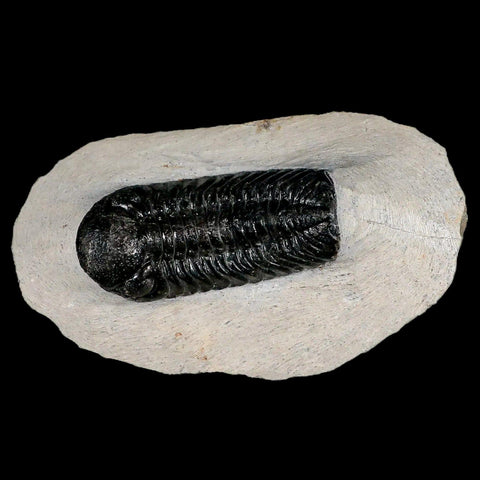
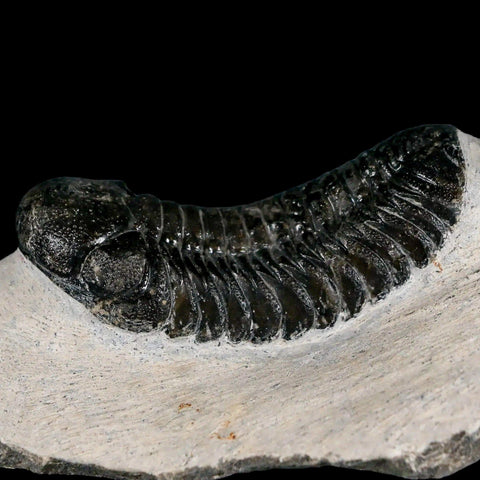
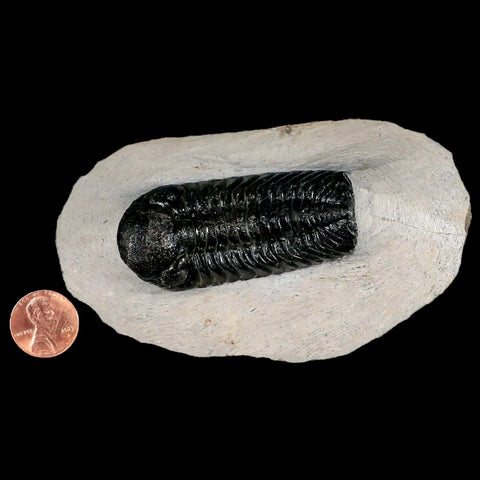
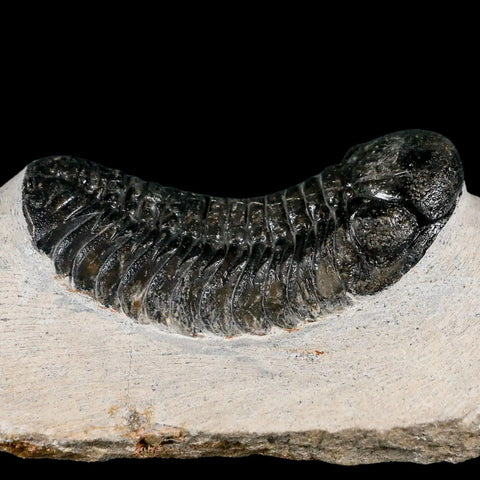
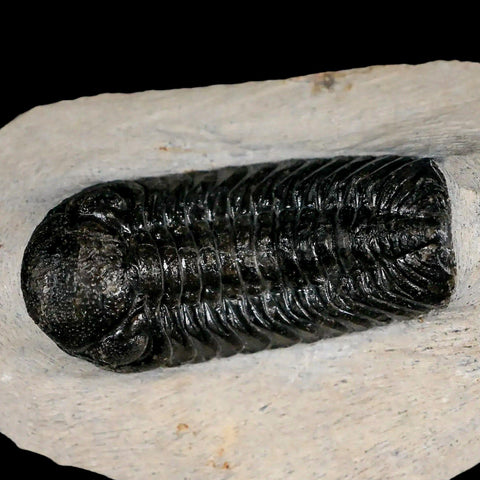
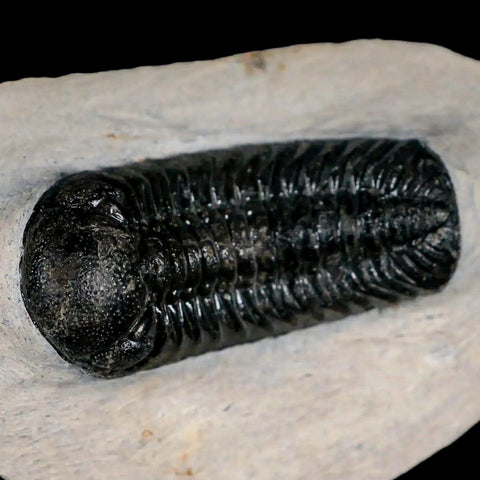
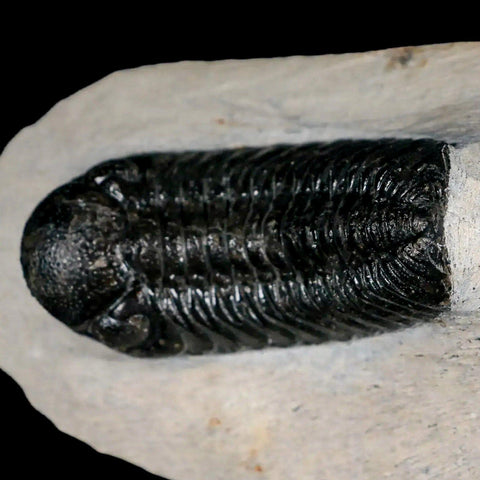
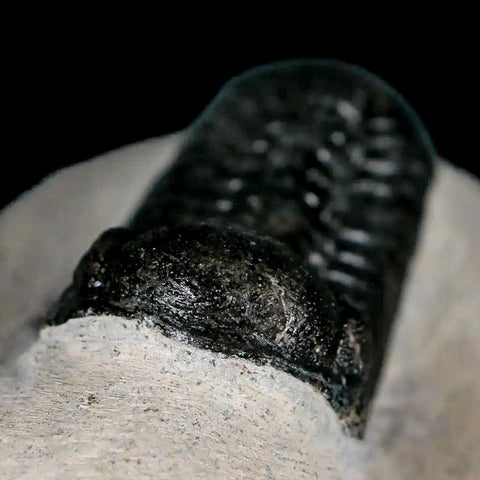
2.5" Moroccops Trilobite Fossil Devonian Morocco 400 Million Years Old COA
Location: Lghaft, Morocco
Weight: 9.6 Ounces
Dimensions: 4.3 Inches Long, 2.6 Inches Wide, 1.4 Inches Thick (Matrix)
Trilobite Dimensions: 2.5 Inches Long, 1.1 Inches Wide, 0.7 Inches Thick
Comes with a Certificate of Authenticity.
The item pictured is the one you will receive.
Moroccops Trilobite
Trilobites were a highly diverse group of extinct marine arthropods classified within the class Trilobita. They first emerged in Earth’s oceans around 521 million years ago during the Early Cambrian period, an event that marks the beginning of the Atdabanian stage in the geological record. For much of the Paleozoic Era, trilobites were among the most abundant and recognizable inhabitants of ancient seas, thriving for hundreds of millions of years before becoming extinct long before the appearance of dinosaurs.
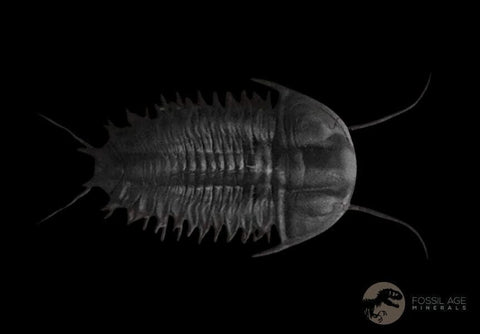
A key evolutionary innovation of trilobites was their rigid exoskeleton, the earliest known skeletal framework developed by animals. This hardened outer shell offered protection from predators and environmental hazards while also allowing their remains to be preserved with remarkable clarity as fossils. Their bodies followed a distinctive three-lobed design, consisting of a central axial lobe bordered by two pleural lobes, a structure that inspired the name trilobite, meaning “three-lobed.”
The trilobite body was divided into three functional regions. The cephalon formed the head and contained compound eyes, feeding structures, and sensory organs such as antennae. The thorax, positioned behind the head, was made up of multiple articulated segments—ranging from just two to more than sixty—which provided flexibility and mobility. At the rear, the pygidium consisted of fused segments that created a protective tail plate.
Trilobites occupied a wide range of marine habitats, from shallow continental shelves to deeper ocean environments. Their exceptional fossil record has made them one of the most important groups for understanding early marine ecosystems, the evolution of arthropods, and the rise of complex life on Earth.

Please be aware of the nature of fossils:
Being buried under the ground for millions of years under tons of pressure tends to be rough. No fossil comes out of the ground whole and perfect. Most fossils have undergone some restoration, while others are altered by man simply to enhance their presentation in different ways. The workers in Morocco do a very professional job of unearthing and preserving these natural treasures; however, natural cracks are visible on the surface. These are part of the natural beauty of the fossil and are not considered defects.