


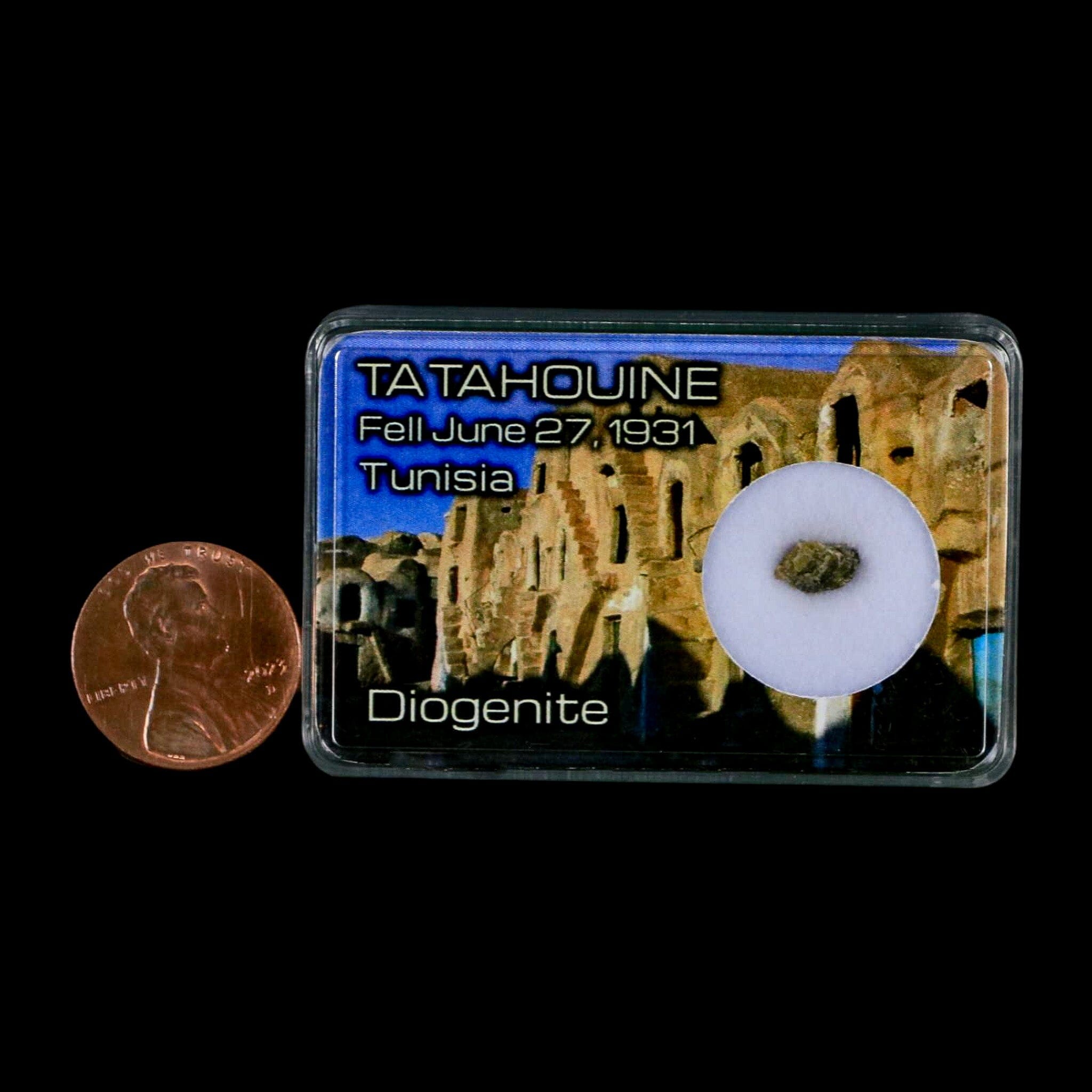


Description
Location: Tunisia
Weight: 0.4 Ounces (Display)
Dimensions: 2.3 Inches Long, 1.5 Inches Wide, 0.6 Inches Thick (Display)
Comes with a Free Display Case.
The item pictured is the one you will receive.
Tatahouine Diogenite is a type of meteorite classified within the group of achondrites, which are stony meteorites that have undergone differentiation and crystallization processes similar to those that occur in planetary bodies. Specifically, diogenites are believed to originate from the asteroid 4 Vesta, one of the largest bodies in the asteroid belt. This classification is part of a broader understanding of meteorites and their origins, which provides insights into the early solar system's formation and evolution.
Diogenites are meteorites primarily composed of orthopyroxene, a mineral rich in iron and magnesium. This mineral gives diogenites their characteristic dark color and dense structure. They may also contain olivine, plagioclase, and various metallic phases. Variations in mineral composition among specimens reflect different cooling histories or processes on their parent body.
The texture of diogenites is typically coarse-grained, resulting from slow cooling that allows larger crystals to form. Some specimens show a cumulate texture, indicating formation by the settling of crystals from molten magma.
Diogenites are closely linked to the geological history of asteroid 4 Vesta. They are believed to have formed from differentiated basaltic magma on Vesta’s surface. As the magma cooled, heavier minerals like orthopyroxene crystallized first and settled toward the bottom of magma chambers. Later, impacts on Vesta ejected these rocks into space, eventually delivering them to Earth as meteorites.
Studying diogenites provides valuable insights into planetary differentiation, revealing how celestial bodies separate into layers based on density, and sheds light on conditions in the early solar system.
Diogenites belong to the HED (Howardite–Eucrite–Diogenite) group of meteorites. Within this classification:
-
Howardites are mixtures of eucrite and diogenite material.
-
Eucrites are basaltic rocks from Vesta with a different mineral composition.
This classification helps researchers trace the origins and evolution of these meteorites and provides context for understanding similar bodies in the solar system.