


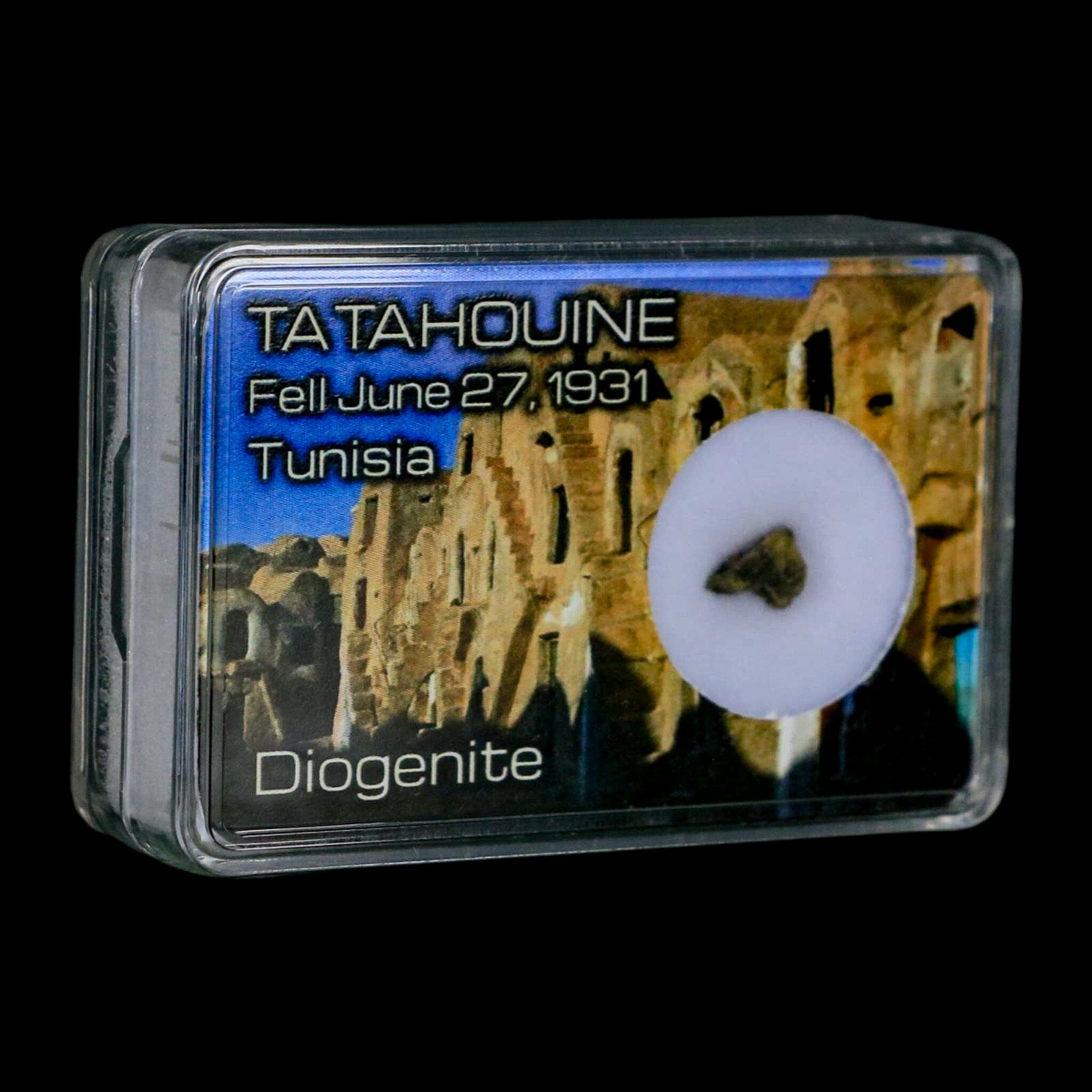


Description
Location: Tunisia
Weight: 0.4 Ounces (Display)
Dimensions: 2.3 Inches Long, 1.5 Inches Wide, 0.6 Inches Thick (Display)
Comes with a Free Display Case.
The item pictured is the one you will receive.
The Tatahouine Diogenite is an achondrite meteorite that fell on June 24, 1931, offering direct evidence of planetary differentiation processes. This specimen is thought to derive from asteroid 4 Vesta, the solar system's second-largest main-belt asteroid, making it scientifically significant for understanding early planetary formation. As a diogenite, Tatahouine is fundamentally composed of orthopyroxene, an iron-magnesium silicate that imparts its distinctive dark appearance and high density. The mineralogical assemblage frequently includes olivine, plagioclase feldspar, and accessory metal phases, with compositional variations reflecting distinct cooling rates and metamorphic conditions experienced within the parent body. For researchers and collectors, this meteorite provides tangible insight into the differentiation mechanisms that shaped terrestrial planets and asteroids during the solar system's infancy, making it an essential specimen for petrographic and geochemical study.
The Tatahouine Diogenite exemplifies the coarse-grained crystalline structure characteristic of meteorites that cooled slowly within their parent body. Many diogenites display cumulate textures, indicating crystal accumulation and gravitational settling within magma chambers on asteroid 4 Vesta. Current models suggest these materials formed from differentiated basaltic magma, with dense orthopyroxene crystallizing early and accumulating in lower crustal zones. Subsequent impact events on Vesta likely excavated and ejected these fragments into heliocentric orbits, eventually delivering them to Earth—this specimen arrived on June 24, 1931. Tatahouine belongs to the HED meteorite group alongside howardites and eucrites, a classification that reflects shared Vestan origins but distinct mineralogical and thermal histories. Analysis of such specimens illuminates planetary differentiation mechanisms, magmatic processes in the early solar system, and the geological evolution of differentiated asteroids, making diogenites invaluable for constraining models of terrestrial planet formation and crustal development.