

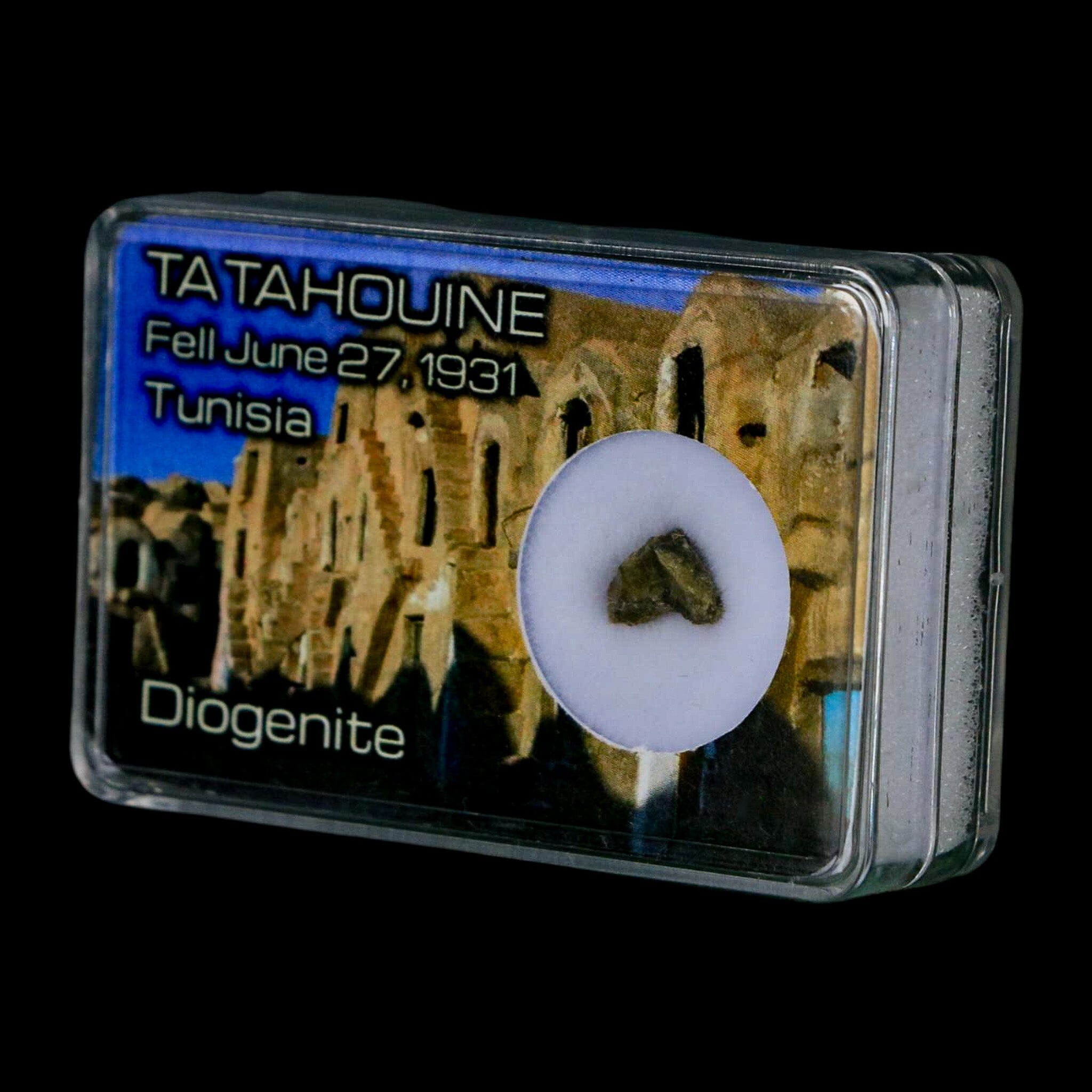


Description
Location: Tunisia
Weight: 0.4 Ounces (Display)
Dimensions: 2.3 Inches Long, 1.5 Inches Wide, 0.6 Inches Thick (Display)
Comes with a Free Display Case.
The item pictured is the one you will receive.
Tatahouine Diogenite is a type of meteorite classified within the group of achondrites, which are stony meteorites that have undergone differentiation and crystallization processes similar to those that occur in planetary bodies. Specifically, diogenites are believed to originate from the asteroid 4 Vesta, one of the largest bodies in the asteroid belt. This classification is part of a broader understanding of meteorites and their origins, which provides insights into the early solar system's formation and evolution.
The Tatahouine diogenite exhibits a mineralogical assemblage dominated by iron and magnesium-rich orthopyroxene, complemented by olivine, plagioclase, and metallic phases whose proportions reflect distinct thermal histories. This compositional framework imparts the specimen's characteristic dark coloration and substantial density. The coarse-grained crystalline texture—a consequence of protracted cooling within Vesta's interior—contrasts markedly with rapidly-cooled meteoritic materials. Many diogenites display cumulate textures, evidence of crystal settling and gravitational stratification within primordial magma chambers. Such petrographic features provide invaluable constraints on cooling rates and the geochemical conditions governing mineral crystallization in differentiated planetary bodies.
Diogenites originated through the differentiation of Vesta, where orthopyroxene-rich minerals crystallized and accumulated within cooling magma chambers. Subsequent asteroidal impacts excavated these dense materials, propelling them into interplanetary space until their eventual arrival on Earth. Examining these specimens illuminates the mechanisms of planetary differentiation—the density-driven stratification fundamental to celestial body evolution—and reveals conditions that prevailed during the early solar system's formation. The Tatahouine diogenite thus serves as a tangible archive of Vesta's geological development and the primordial processes that shaped our cosmic neighborhood.
Tatahouine diogenites represent a distinct category within the HED meteorite classification system, alongside howardites and eucrites—all believed to originate from the asteroid Vesta. While eucrites display basaltic characteristics with unique mineral assemblages, diogenites are orthopyroxene-rich rocks that offer crucial insights into planetary differentiation. Howardites, conversely, represent composite materials blending both eucrite and diogenite components. This taxonomic framework enables scientists to reconstruct the thermal and compositional evolution of early solar system bodies, illuminating the geological processes that shaped Vesta and comparable celestial objects.