
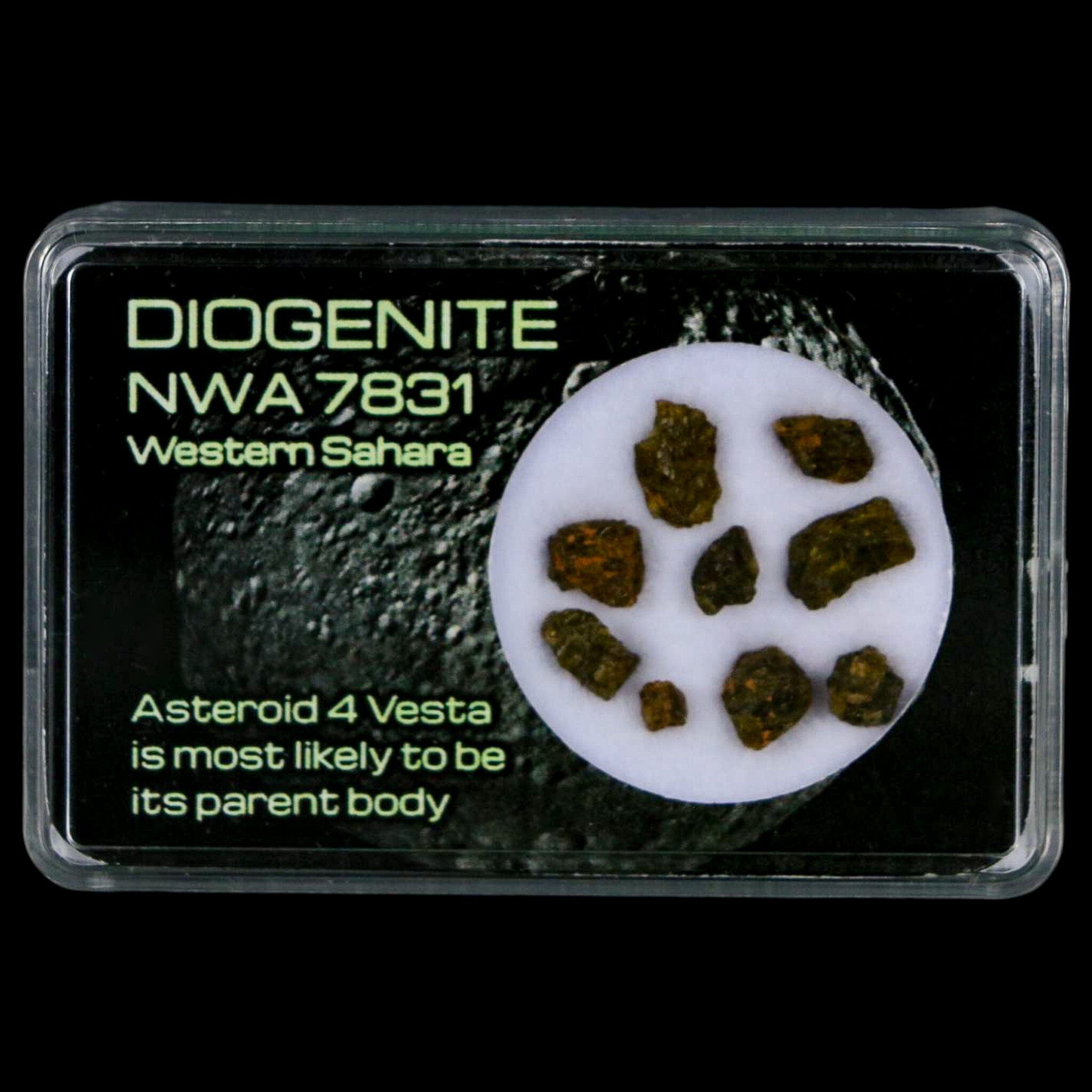


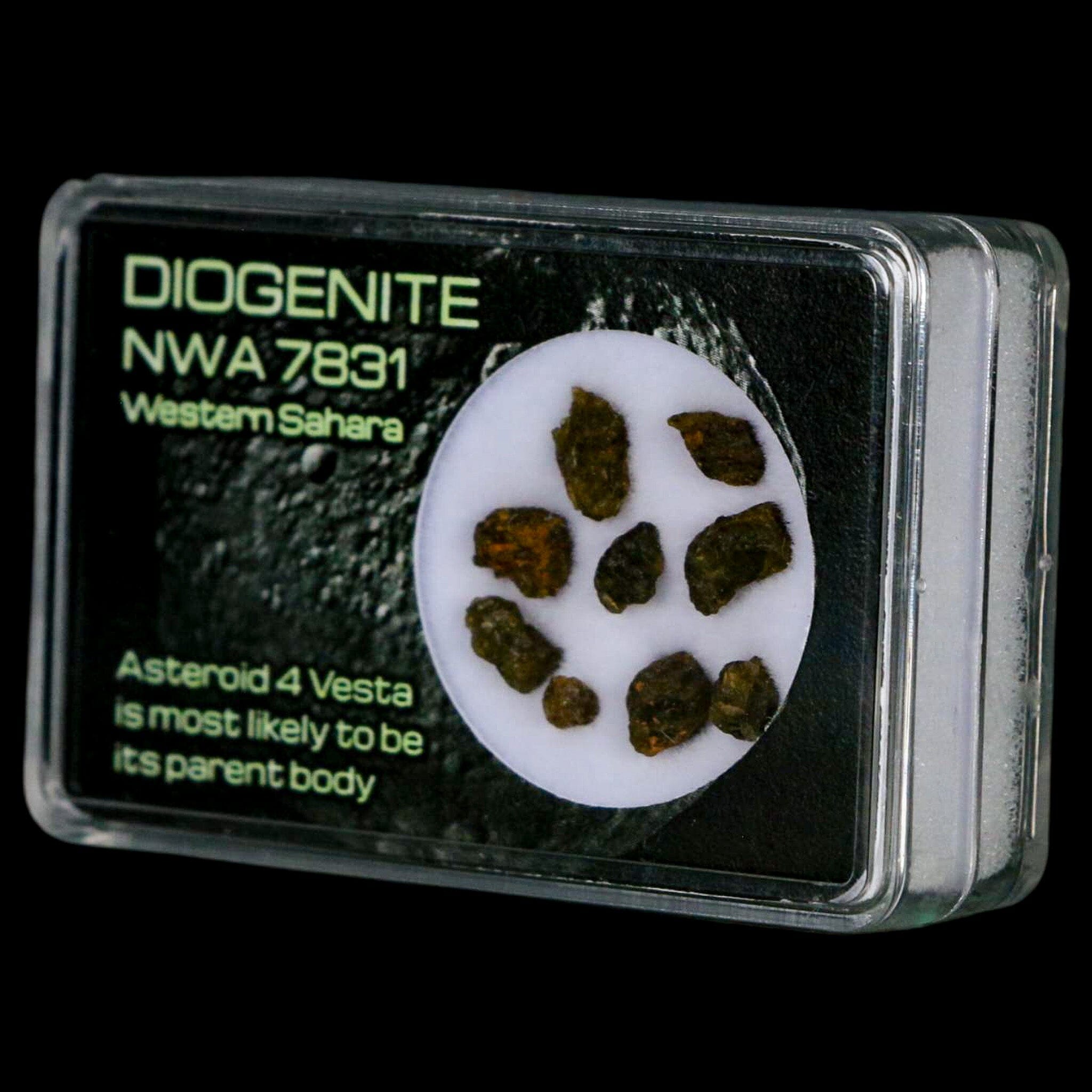


Description
Location: Western Sahara
Weight: 0.4 Ounces (Display)
Dimensions: 2.3 Inches Long, 1.5 Inches Wide, 0.6 Inches Thick (Display)
Comes with a Free Display Case.
The item pictured is the one you will receive.
Diogenite meteorites are igneous achondrites that formed within a differentiated planetary body rather than as primitive solar nebula material. They are widely accepted to have originated from the asteroid 4 Vesta, whose internal melting and magmatic activity produced a layered structure similar to that of small terrestrial planets.
These meteorites are composed predominantly of orthopyroxene, accompanied in lesser amounts by olivine, plagioclase feldspar, and accessory metal phases. The dominance of orthopyroxene reflects crystallization from magnesium- and iron-rich magmas. Variations in mineral chemistry among specimens record differing depths of formation and cooling conditions within the Vestan interior.
Diogenites typically exhibit a coarse crystalline fabric, indicating slow cooling beneath the surface. Many represent cumulate rocks, formed as early-crystallizing minerals accumulated at the base of magma reservoirs. This texture distinguishes diogenites from volcanic meteorites that cooled rapidly at or near the surface.
Their delivery to Earth is attributed to large impact events on Vesta that excavated deep-seated material and ejected it into space. Over time, fragments entered Earth-crossing orbits and survived atmospheric passage as meteorites.
Within meteorite classification, diogenites belong to the HED clan—Howardites, Eucrites, and Diogenites—which together document the magmatic evolution, crust–mantle differentiation, and impact history of one of the best-studied asteroidal bodies in the solar system.