
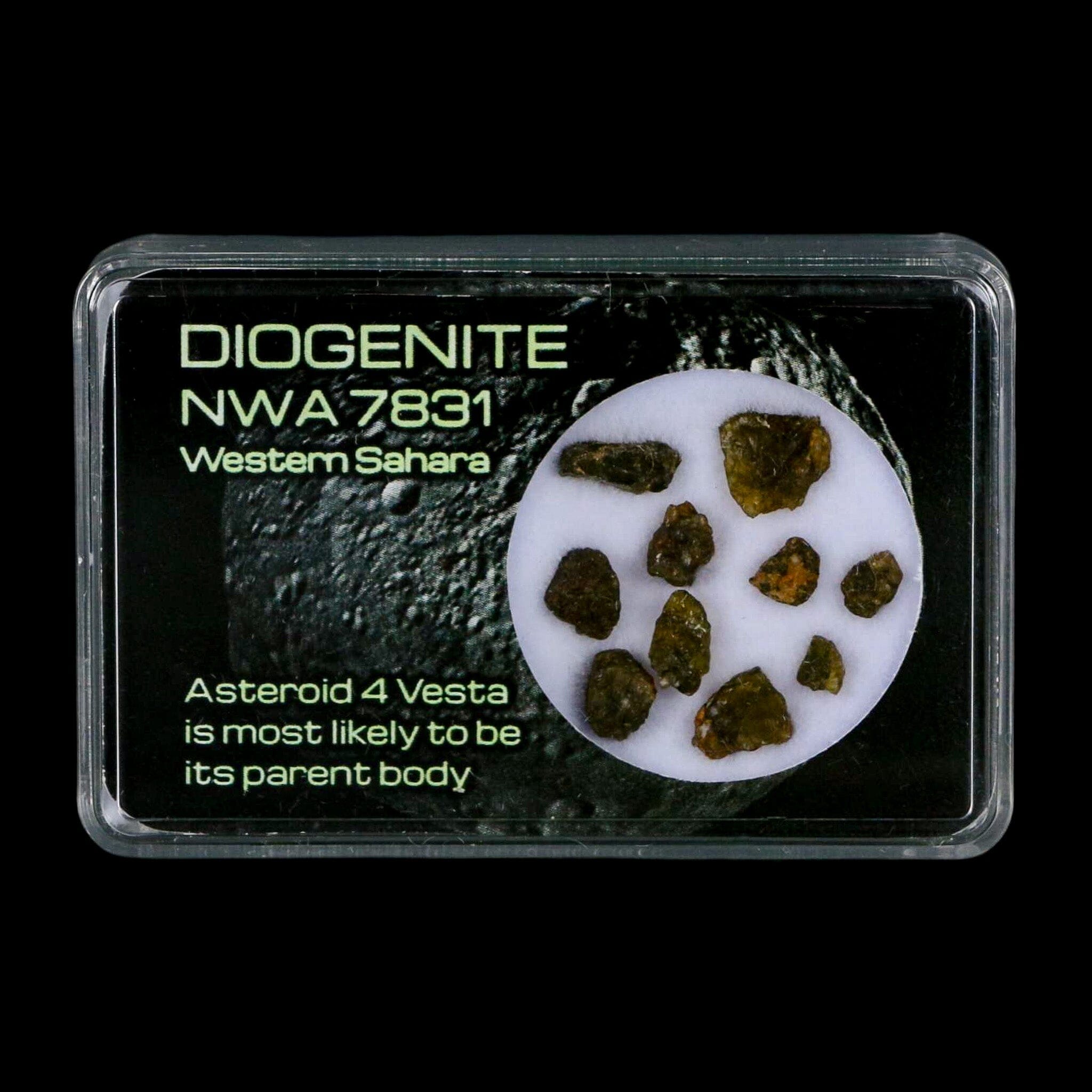


Description
Location: Western Sahara
Weight: 0.4 Ounces (Display)
Dimensions: 2.3 Inches Long, 1.5 Inches Wide, 0.6 Inches Thick (Display)
Comes with a Free Display Case.
The item pictured is the one you will receive.
Diogenites are a class of achondritic stony meteorites formed through igneous processes rather than primitive accretion. Unlike chondrites, these meteorites experienced melting and internal differentiation, similar to the geological activity seen on small planetary bodies. Scientific evidence strongly indicates that diogenites originated on asteroid 4 Vesta, one of the most massive objects in the main asteroid belt.
Their formation reflects a period when Vesta possessed sufficient heat to generate magma and develop a layered interior. Material from these deeper igneous regions was later excavated by large impact events and ejected into space, eventually reaching Earth as meteorites. The study of diogenites plays an important role in understanding early planetary evolution, offering direct evidence of magmatic activity and crust–mantle differentiation in the early solar system.
This remarkable diogenite specimen showcases the rich mineralogical heritage of asteroid 4 Vesta, built primarily from iron and magnesium-rich orthopyroxene that creates its striking dark coloration and substantial weight. Alongside orthopyroxene, these meteorites often feature olivine, plagioclase, and metallic components, with each specimen's unique composition telling its own story of cooling rates and planetary processes. The characteristically coarse-grained texture reveals the slow, deliberate crystallization that allowed crystals to develop impressively large sizes—a testament to the ancient conditions within Vesta's magma chambers. Many diogenites display cumulate textures, beautiful evidence of how crystals once accumulated and settled within molten environments. Scientists believe these meteorites originated from differentiated basaltic magma on Vesta's surface; as the asteroid gradually cooled, denser minerals crystallized and sank toward the bottom of magma chambers before violent impacts eventually launched them toward Earth. Studying diogenites helps us understand planetary differentiation and the remarkable conditions of our early solar system. Classified within the HED meteorite group alongside howardites and eucrites, these specimens offer collectors and researchers alike an extraordinary opportunity to connect with Vesta's geological evolution and explore the diverse planetary bodies that shaped our cosmic neighborhood.