

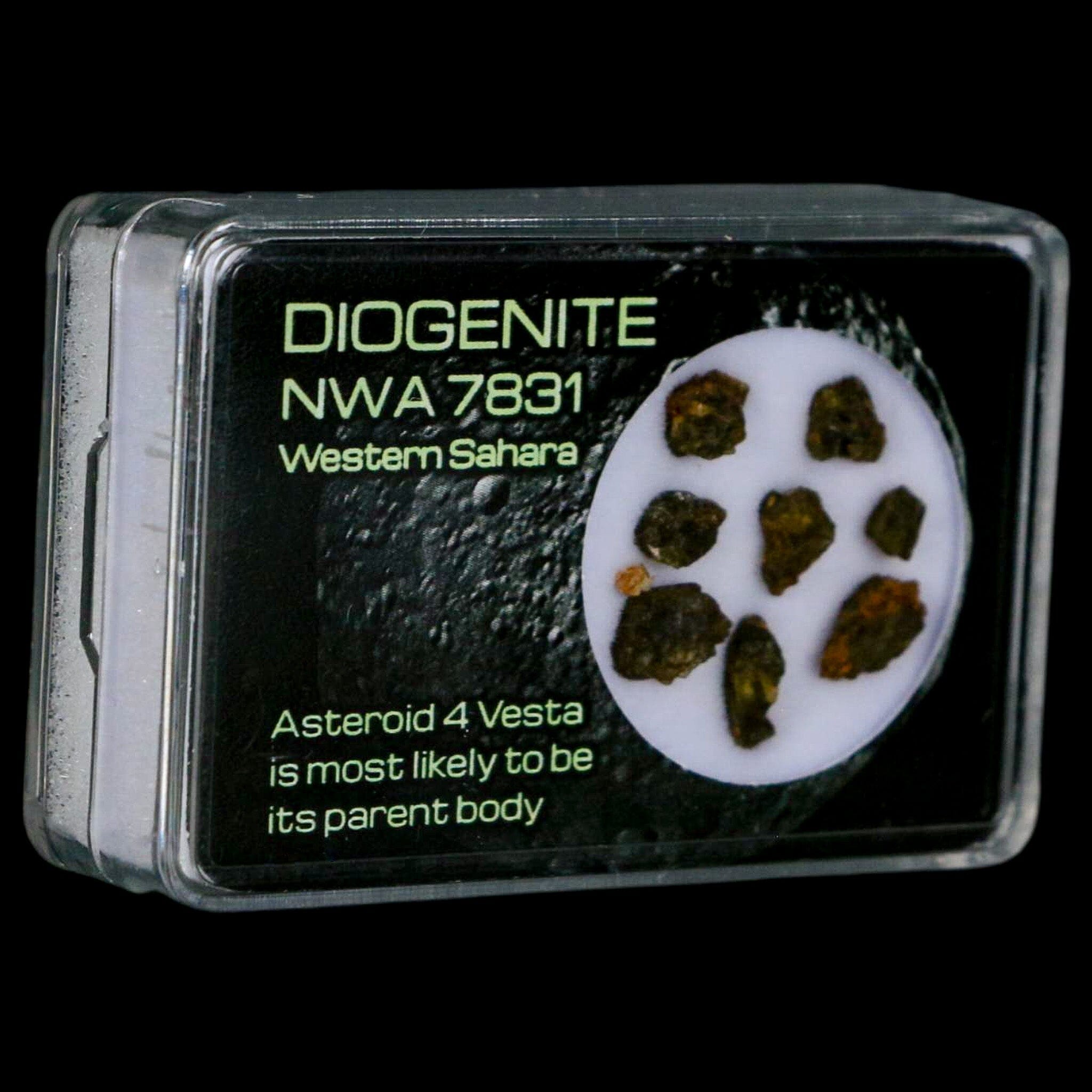
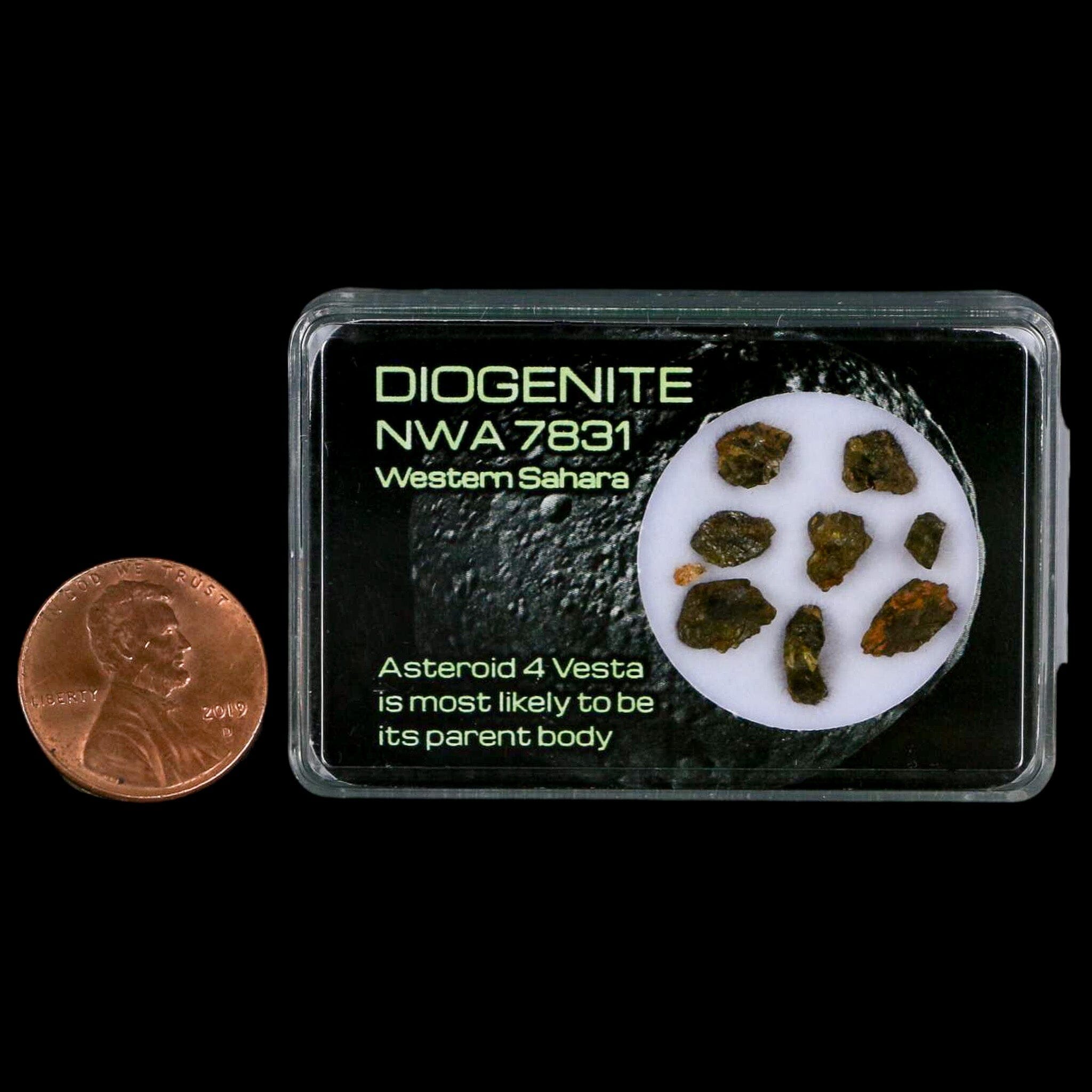


Description
Location: Western Sahara
Weight: 0.4 Ounces (Display)
Dimensions: 2.3 Inches Long, 1.5 Inches Wide, 0.6 Inches Thick (Display)
Comes with a Free Display Case.
The item pictured is the one you will receive.
Diogenites belong to the achondrite class of stony meteorites, meaning they formed through igneous processes rather than remaining in a primitive, unmelted state. These meteorites crystallized from molten material and record internal geological activity similar to that seen on small planetary bodies. Extensive research links diogenites to asteroid 4 Vesta, a differentiated protoplanet within the main asteroid belt.
Their composition and structure reflect a time when Vesta experienced intense heating, allowing magma to form and solidify beneath its surface. Subsequent impact events ejected fragments of this deep-seated material into space, some of which eventually reached Earth. As a result, diogenites provide valuable insight into planetary differentiation and the dynamic processes that shaped the early solar system.
This rare Vesta fragment shatters our understanding of planetary evolution. Dominated by iron-magnesium orthopyroxene, diogenites emerged from violent cosmic processes—molten magma chambers where heavy minerals sank and crystallized into coarse-grained structures before catastrophic impacts blasted them across the solar system. Each specimen tells a story of ancient differentiation, when celestial bodies sorted themselves by density in the primordial chaos. Alongside olivine, plagioclase, and metallic phases, these HED meteorites reveal how worlds were built and destroyed. Western Sahara's desert sands preserved this messenger from the asteroid belt, offering direct evidence of conditions that shaped our solar system 4.5 billion years ago. Own a piece of cosmic violence and planetary transformation.
This classification aids researchers in tracing back the origins and evolutionary history of these celestial materials while providing context for understanding similar bodies throughout our solar system.