


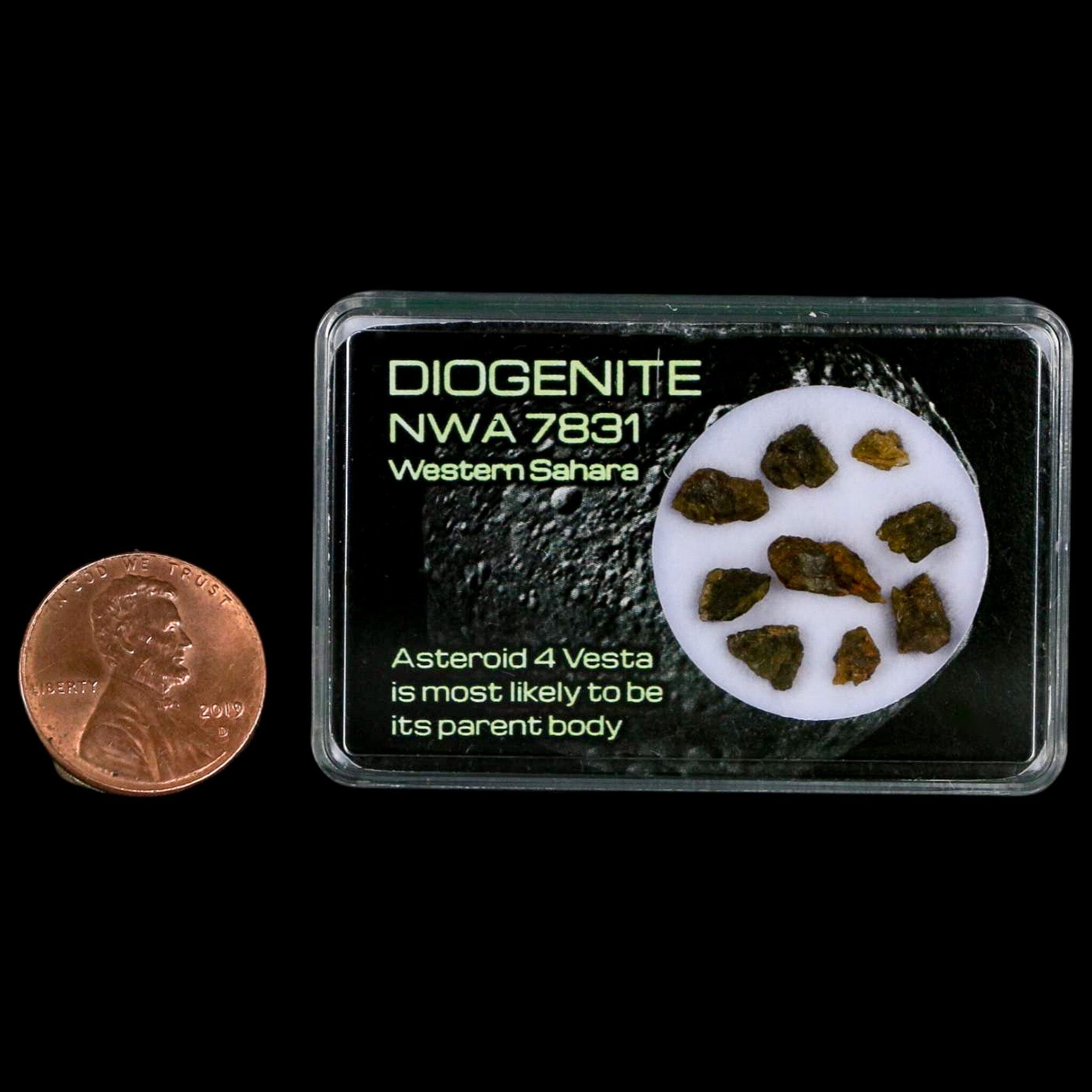


Description
Location: Western Sahara
Weight: 0.4 Ounces (Display)
Dimensions: 2.3 Inches Long, 1.5 Inches Wide, 0.6 Inches Thick (Display)
Comes with a Free Display Case.
The item pictured is the one you will receive.
Diogenites are a rare class of achondritic meteorites, meaning they are stony meteorites that formed through melting and internal differentiation within a planetary body rather than remaining primitive. Scientific evidence links diogenites to asteroid 4 Vesta, one of the largest and most geologically evolved objects in the asteroid belt. These meteorites offer direct insight into the internal structure and early evolution of small planetary bodies in the solar system.
Mineralogically, diogenites are dominated by orthopyroxene, an iron- and magnesium-rich silicate mineral responsible for their dark coloration and substantial density. Minor constituents may include olivine, plagioclase feldspar, and trace metallic phases. Differences in mineral proportions between specimens reflect variations in crystallization conditions and depth within the parent body.
Diogenites typically exhibit a coarse-grained crystalline texture, formed through prolonged cooling deep below the surface of Vesta. This slow-cooling environment allowed large mineral crystals to develop. Many diogenites show evidence of a cumulate origin, indicating that early-forming crystals settled and accumulated within magma chambers as molten material differentiated.
Their formation is closely tied to Vesta’s magmatic history. As basaltic magma cooled, dense minerals such as orthopyroxene crystallized early and migrated downward, forming layered igneous deposits. Subsequent impact events excavated these deep-seated rocks and ejected them into space, where a small number eventually intersected Earth’s orbit and survived atmospheric entry.
Diogenites are part of the HED meteorite group, which also includes eucrites and howardites. Together, these meteorites represent different structural levels of Vesta, from crustal basalts to deeper plutonic rocks. The study of diogenites enhances our understanding of planetary differentiation, magmatic processes, and the conditions that shaped the early solar system.