
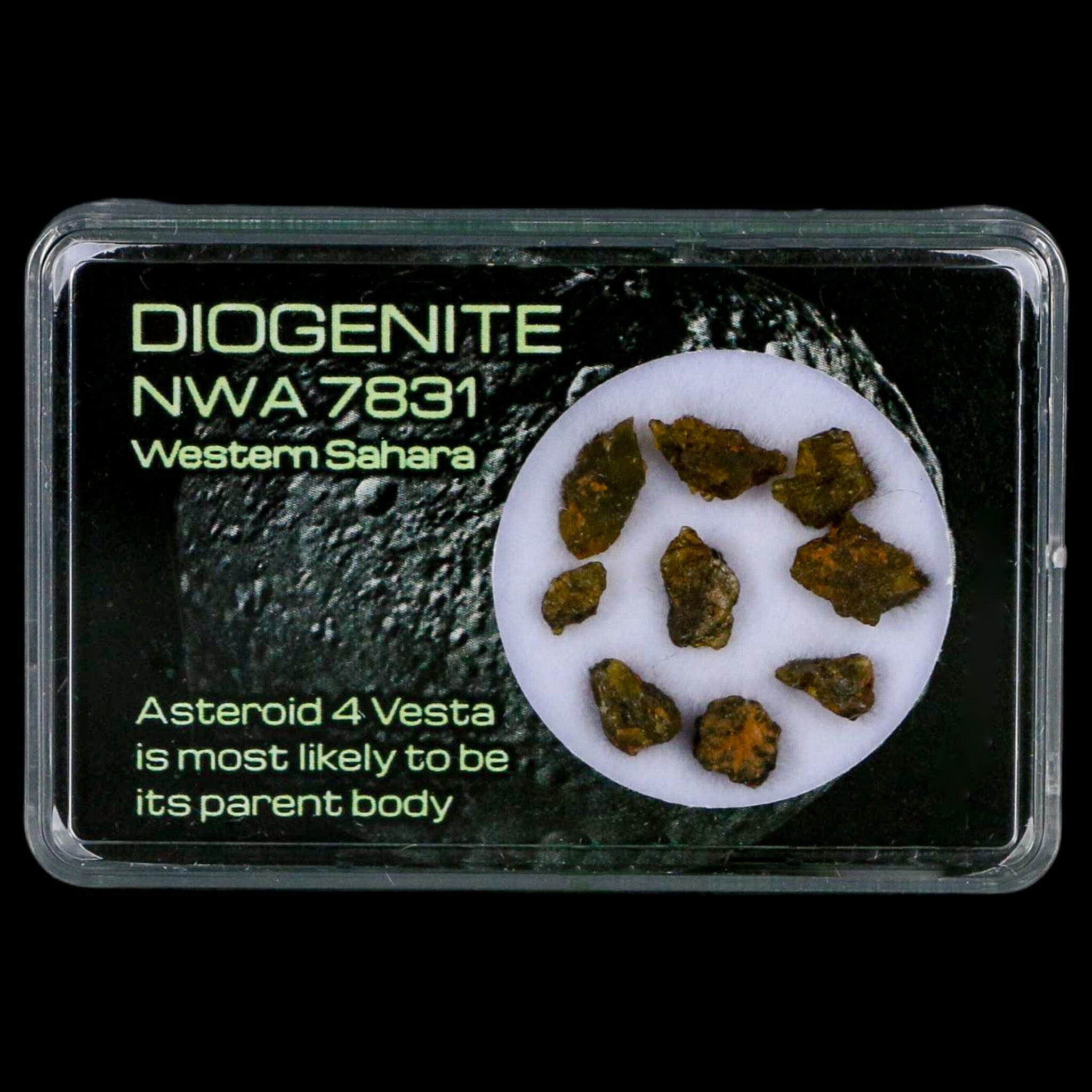


Description
Location: Western Sahara
Weight: 0.4 Ounces (Display)
Dimensions: 2.3 Inches Long, 1.5 Inches Wide, 0.6 Inches Thick (Display)
Comes with a Free Display Case.
The item pictured is the one you will receive.
Diogenites belong to the achondrite class of meteorites, a group of stony meteorites formed through internal melting and differentiation within their parent bodies. Unlike primitive chondrites, achondrites record geological processes similar to those that shape planets. Diogenites are widely accepted to have originated from asteroid 4 Vesta, one of the largest and most geologically evolved objects in the asteroid belt.
This classification places diogenites within a framework that helps scientists trace the early history of the solar system. By studying these meteorites, researchers gain valuable insight into planetary formation, magmatic activity, and the processes that led to the differentiation of early celestial bodies.
Diogenites are primarily composed of orthopyroxene, a mineral that is rich in iron and magnesium. The presence of this mineral gives diogenites their characteristic dark color and dense structure. In addition to orthopyroxene, diogenites may contain other minerals such as olivine, plagioclase, and various metallic phases. The specific mineralogical composition can vary among individual specimens, reflecting different cooling histories or parent body processes.
Diogenites are noted for their coarse-grained crystalline texture, a feature that reflects their slow cooling deep within a parent body. Extended cooling periods allowed large mineral crystals to develop, distinguishing diogenites from more rapidly cooled meteorites. Many specimens display a cumulate structure, formed when dense crystals settled and accumulated at the base of magma bodies during solidification.
Their origin is closely tied to the geological evolution of asteroid 4 Vesta. Diogenites are thought to have formed from differentiated basaltic magmas beneath Vesta’s surface. As these magmas cooled, early-forming minerals—particularly orthopyroxene—crystallized and sank within magma chambers. Subsequent impact events on Vesta later excavated these deep-seated rocks, ejecting fragments into space that ultimately reached Earth as meteorites.
Because of this history, diogenites provide critical evidence for planetary differentiation, the process by which early solar system bodies separated into distinct layers based on density and composition. Studying these meteorites helps scientists reconstruct conditions present during the earliest stages of planetary formation.
Diogenites are part of the HED meteorite group, which also includes howardites and eucrites. Howardites are brecciated mixtures of eucritic and diogenitic material, while eucrites represent basaltic crustal rocks from Vesta. Together, the HED suite offers a comprehensive view of the internal structure and evolutionary history of a differentiated asteroid.