


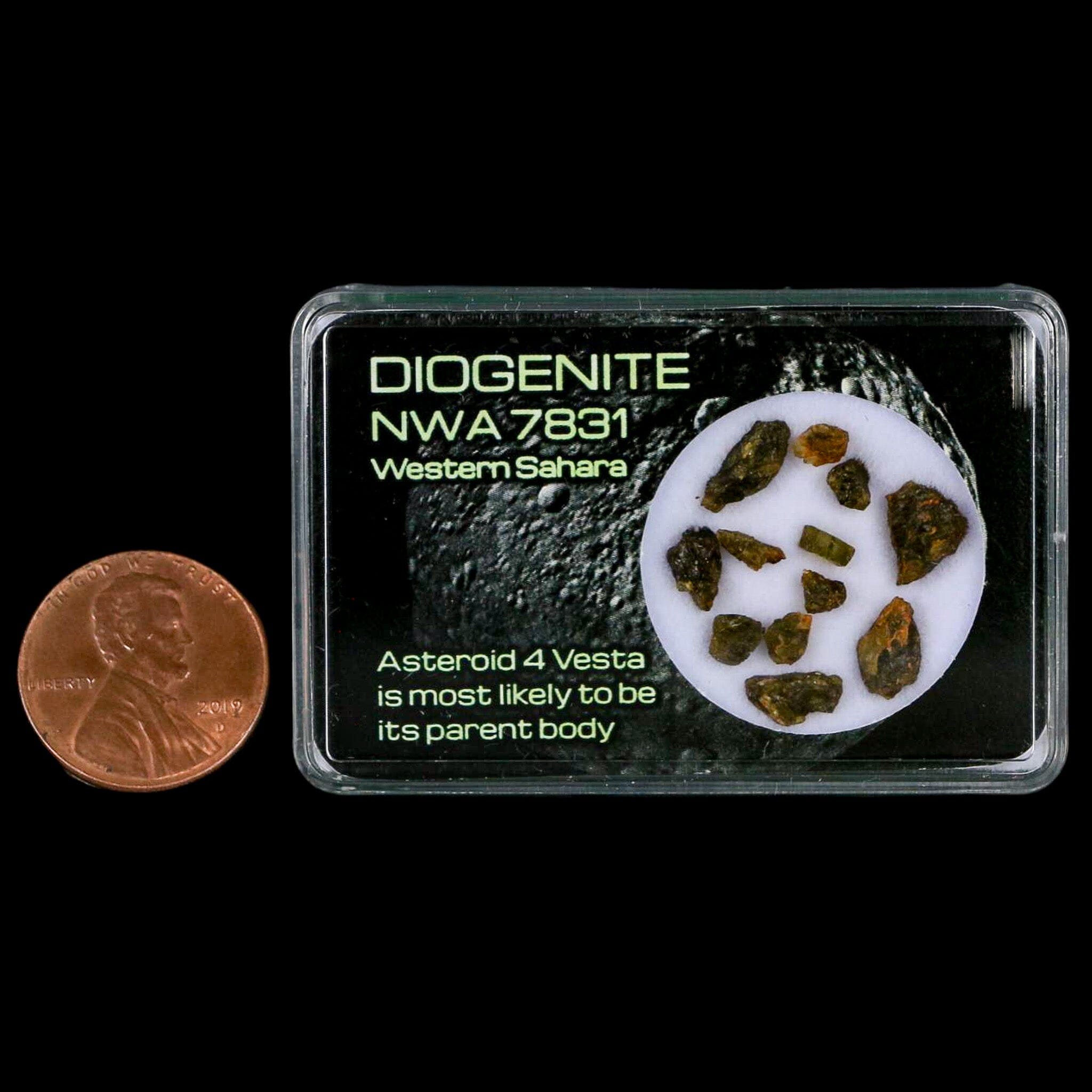


Description
Location: Western Sahara
Weight: 0.4 Ounces (Display)
Dimensions: 2.3 Inches Long, 1.5 Inches Wide, 0.6 Inches Thick (Display)
Comes with a Free Display Case.
The item pictured is the one you will receive.
Diogenite is a stony meteorite belonging to the achondrite group, which consists of meteorites that have undergone differentiation and crystallization processes similar to those of planetary bodies. Diogenites are thought to originate from the asteroid 4 Vesta, one of the largest objects in the asteroid belt. Studying these meteorites provides important insights into the formation and early evolution of the solar system.
Diogenites consist predominantly of orthopyroxene, an iron- and magnesium-rich silicate mineral that contributes to their dark appearance and high density. Alongside orthopyroxene, these meteorites may include minor amounts of olivine, plagioclase, and metallic phases. Variations in mineral composition from one specimen to another reflect differences in crystallization conditions, cooling rates, and geological processes within their parent body.
Diogenites commonly display a coarse-grained crystalline texture, a result of prolonged cooling within their parent body. This extended cooling period allowed mineral crystals to grow to relatively large sizes, distinguishing diogenites from more rapidly cooled meteorites. Many specimens exhibit a cumulate structure, formed when dense mineral crystals settled and accumulated at the base of magma bodies during solidification.
The origin of diogenites is intimately connected to Vesta’s geological evolution. These meteorites are thought to have crystallized from differentiated basaltic magma on Vesta’s surface. As the asteroid cooled, dense minerals such as orthopyroxene solidified first and accumulated at the base of magma chambers. Subsequent impacts on Vesta likely dislodged these rocks, launching them into space, where they ultimately reached Earth as meteorites.
The study of diogenites provides valuable information about planetary differentiation processes—how celestial bodies separate into layers based on density—and helps scientists understand the conditions present in the early solar system.
Diogenites are classified within a broader meteorite scheme based on their mineralogical and chemical characteristics. They belong to the HED (Howardite–Eucrite–Diogenite) group, which also includes howardites and eucrites. Howardites consist of mixtures of eucrite and diogenite material, while eucrites are basaltic rocks originating from Vesta with mineral compositions distinct from diogenites.
This classification aids researchers in tracing back the origins and evolutionary history of these celestial materials while providing context for understanding similar bodies throughout our solar system.