


4.6" Plesiosaur Fossil Vertebrae Cretaceous Dinosaur Era Morocco Zarafasaura COA
Location: Khouribga, Morocco
Weight: 1 Pound 9.6 Ounces
Dimensions: 4.6 Inches Long, 3.5 Inches Wide, 2.2 Inches Thick
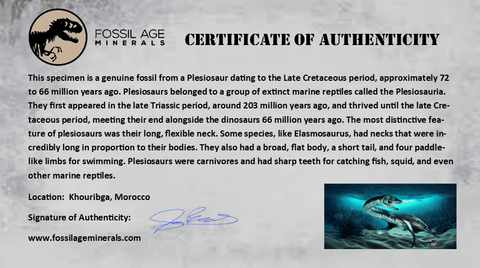
Comes with a Certificate of Authenticity.
The item pictured is the one you will receive.
This is a genuine fossil.
Plesiosaur Zarafasaura
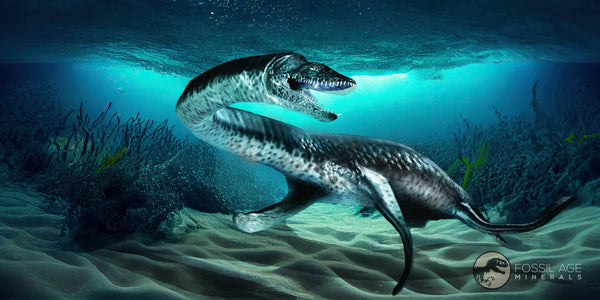
Zarafasaura oceanis is a long-necked elasmosaurid marine reptile that lived during the Late Cretaceous period, approximately 72 to 66 million years ago, reaching lengths of about 23 feet (7 meters). Classified within the family Elasmosauridae, its genus name combines the Arabic word Aarafa, meaning “giraffe,” with the Greek Saurus, meaning “lizard,” reflecting its elongated neck and reptilian features. The species epithet oceanis translates as “daughter of the sea” in Latin. This species was formally described in 2011 by paleontologist Dr. Peggy Vincent and her team at the National Museum of Natural History in Paris, based on partial skull fossils discovered in Morocco. Zarafasaura oceanis was a carnivorous predator that inhabited marine environments, likely feeding on fish and other small aquatic animals, demonstrating adaptations typical of elasmosaurids, including a streamlined body and powerful flippers for swimming.
Closely related to Zarafasaura, Plesiosaurus is one of the most recognizable genera within the Plesiosauriae family. Plesiosaurus lived in marine environments from approximately 228 million to 61.6 million years ago and was also a carnivore, preying on fish and other marine creatures. Fossil records include 938 documented specimens, making it one of the best-studied plesiosaurs. Despite this, artistic depictions often do not clearly distinguish Plesiosaurus from other plesiosaur genera and are frequently influenced by cryptozoological myths, particularly stories surrounding the Loch Ness Monster. Together, Zarafasaura oceanis and Plesiosaurus highlight the diversity of marine reptiles during the Mesozoic Era and provide valuable insight into prehistoric ocean ecosystems, predator-prey dynamics, and plesiosaur evolution.
Please be aware of the nature of fossils:
Being buried under the ground for millions of years under tons of pressure tends to be rough. No fossil comes out of the ground whole and perfect. Most fossils have undergone some restoration, while others are altered by man simply to enhance their presentation in different ways. The workers in Morocco do a very professional job of unearthing and preserving these natural treasures; however, commonly, natural cracks are visible on the surface. These are part of the natural beauty of the fossil and are not considered defects.


