






Description
Location: Lance Creek Formation, Weston County, Wyoming (Private Land Origin)
Weight: 0.5 Ounces
Dimensions: 1.1 Inches Long, 0.5 Inches Wide, 0.3 Inches Thick
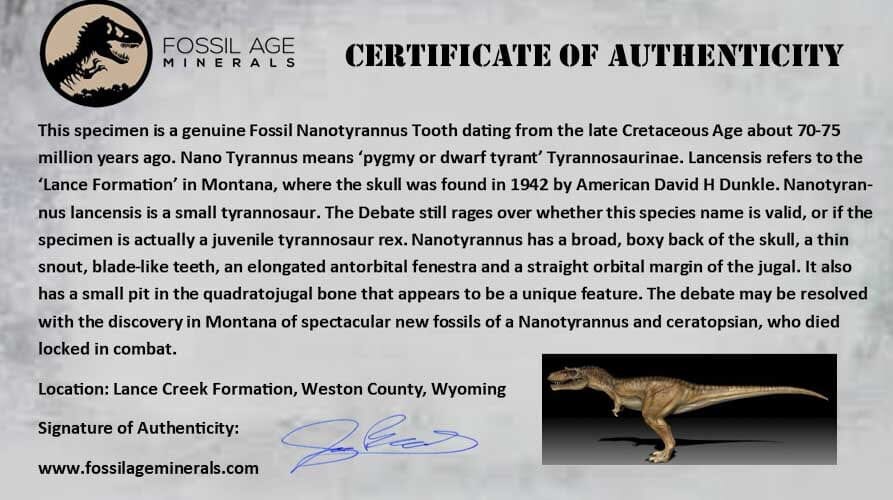
Comes with a Certificate of Authenticity.
Comes with a Free Display.
The item pictured is the one you will receive.
This is a genuine fossil.
Late Cretaceous, 67 Million Years Old
Name: Nanotryannus
Type: Carnivore
Size: 5 meters in length.
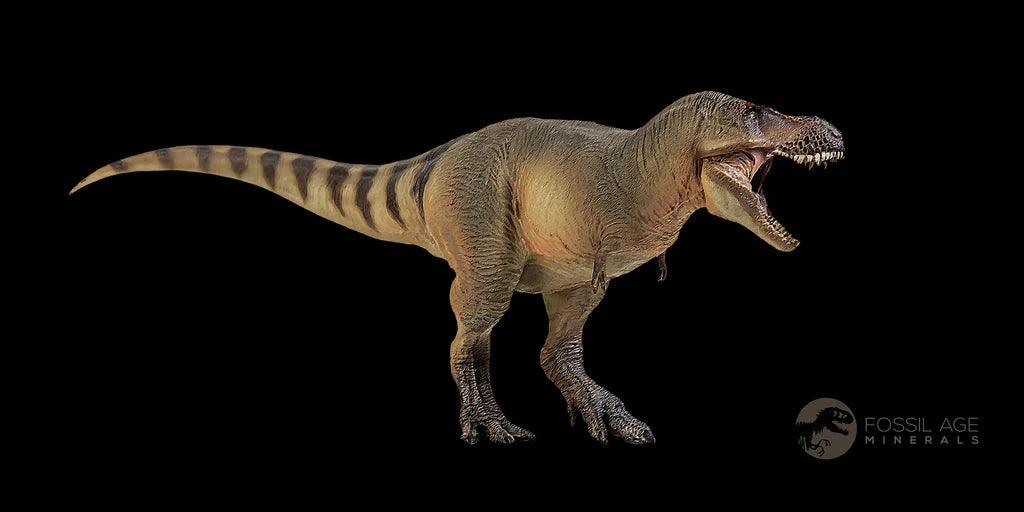
Nanotyrannus, meaning “dwarf tyrant,” is a debated genus within tyrannosaurid dinosaurs that is widely considered by paleontologists to represent a juvenile Tyrannosaurus rex. Fossils of Nanotyrannus are known from a small skull dating between 72.1 and 66 million years ago, during the Late Cretaceous period. This dinosaur is primarily distinguished from adult T. rex by tooth count and cranial structure: Nanotyrannus has 14–15 teeth per side in the maxilla and 16 per side in the lower jaw, compared to T. rex’s 11–12 and 11–14 teeth, respectively, along with partially fused cranial bones.
Despite its smaller size, Nanotyrannus was a capable predator. Evidence suggests it may have hunted in packs or pairs, targeting large herbivorous dinosaurs such as ceratopsians and hadrosaurs. Its sharp teeth and agile build made it effective at hunting or scavenging, demonstrating complex predatory strategies within Late Cretaceous ecosystems.
The study of Nanotyrannus provides important insight into juvenile tyrannosaurid growth and development, shedding light on how young T. rex matured into apex predators. Its distinct dental and cranial features help paleontologists understand ontogeny—the changes that occur as dinosaurs grew from juveniles to adults—and the variations in hunting behavior and anatomy during different life stages.
Nanotyrannus remains a fascinating subject for dinosaur enthusiasts, paleontologists, and fossil collectors, highlighting the diversity and adaptability of tyrannosaurids in the Late Cretaceous. Its controversial classification continues to spark discussion, while its fossils provide valuable clues about the behavior, anatomy, and ecological role of juvenile tyrannosaurids within North America’s prehistoric landscapes.
