




4.5" Ichthyosaurus Fossil Bone Section Dorset England Jurassic Marine Reptile COA
Location: Dorset, England (Dorset Coast)
Weight: 1 Pound 5.4 Ounces
Dimensions: 4.5 Inches Long, 3.5 Inches Wide, 2 Inches Thick.
Comes with a Certificate of Authenticity.
The item pictured is the one you will receive.
Upper Jurassic Age, 145 Million Years old.
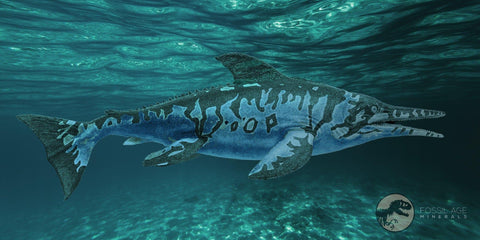
Ichthyosaurs were highly specialized marine reptiles that thrived in the world’s oceans around 145 million years ago, most notably during the Early Jurassic period. Their name, meaning “fish lizard” in Greek, reflects their streamlined, fish-like appearance and was inspired by early fossil discoveries in England during the early nineteenth century. The term Ichthyosaur was formally introduced in 1818 by Charles König, while pioneering fossil collector Mary Anning played a crucial role in uncovering some of the earliest and most complete specimens.
Throughout the nineteenth century, ichthyosaur fossils were commonly assigned to the genus Ichthyosaurus, which by 1900 included more than fifty named species. These marine reptiles were perfectly adapted for life in open water, with sleek bodies built for speed. Propulsion came primarily from powerful tail strokes, aided by well-developed fins and short, paddle-like fingers, allowing them to maneuver efficiently through the sea.
Although they lived entirely in marine environments, ichthyosaurs were air-breathing predators, belonging to the reptilian group Ichthyosauria. A typical Ichthyosaurus measured about 6 feet (1.8 meters) in length and weighed roughly 200 pounds, making it comparable in size and weight to an adult human. Its jaws were lined with numerous small, razor-sharp teeth, ideally suited for catching fish, which formed the bulk of its diet, along with squid-like cephalopods that were abundant in Jurassic oceans.
Ichthyosaurs represent one of the most striking examples of convergent evolution, evolving body shapes remarkably similar to modern dolphins, demonstrating how marine life repeatedly adapts to the demands of fast, efficient swimming in the open ocean.
