


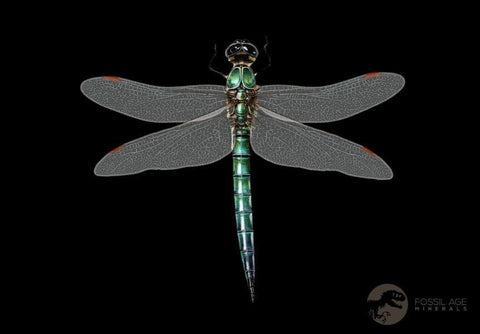


0.6" Dragonfly Larvae Fossil Libellula Doris Plate Upper Miocene Piemont Italy Display
Location: Piemonte Area, Santa Vittoria d’Alba. Italy
Weight: 2 Ounces With Display.
Dimensions: 3.3 Inches Long, 2.5 Inches Wide, 1 Inch Thick (Display)
Dimensions: 2 Inches Long, 1.5 Inches Wide, 0.2 Inches Thick (Plate)
Insect Dimensions: 0.6 Inches Long, 0.6 Inches Wide
Comes with a Free White Display Box.
Comes with a Certificate of Authenticity.
The item pictured is the one you will receive.
Upper Miocene, 16 Million-Year-old
Fossil Dragonfly Larvae, Libellula Doris
The dealer from whom this exquisite insect plate was acquired has exclusive access to a special shale outcrop located in the foothills of the Alps, where these rare specimens are carefully quarried. The thin shale plate features three complete dragonfly fossils, beautifully arranged in a natural, aesthetic composition. Each specimen is remarkably detailed, with fine preservation of wing venation and body structure, offering exceptional visual appeal and scientific interest.
Libellula is a genus of extant dragonflies commonly known as “Skimmers.” Many members of this genus are notable for their vibrant coloration and intricately banded wings. Dragonflies belong to the order Odonata and the family Libellulidae, distinguished by the hindwing being broader than the forewing. They possess large, multifaceted eyes, two pairs of strong, transparent wings, and an elongated body.
Although often confused with damselflies, dragonflies can be distinguished by their wing position at rest—their wings extend outward, perpendicular to the body. Like other insects, they have six legs; however, their legs are poorly adapted for walking. Instead, dragonflies are among the most agile and fastest-flying insects in the world, capable of sudden changes in direction and remarkable hovering ability.
In their ecosystems, dragonflies are crucial aerial predators, feeding on mosquitoes, flies, ants, bees, wasps, and occasionally butterflies. They are most commonly found around freshwater environments—marshes, ponds, lakes, and wetlands—since their larvae, known as nymphs or naiads, are aquatic.
Female dragonflies deposit their eggs in or near water, often on floating vegetation. In some species, females even submerge completely to attach eggs to submerged surfaces. The eggs hatch into naiads, which spend most of their lives underwater, preying on smaller aquatic creatures using extendable, grasping jaws. Naiads breathe through rectal gills and can move rapidly by expelling water through the anus—a form of natural jet propulsion.
This larval stage may last up to five years in large species (or several months in smaller ones). When fully developed, the naiad climbs onto an emergent plant, where exposure to air triggers metamorphosis. The exoskeleton splits behind the head, and the adult dragonfly emerges, expands its wings, and takes flight.
Adult dragonflies are extraordinary fliers, capable of moving in six directions—forward, backward, upward, downward, and side to side—with precise control. Depending on the species, adults can live from a few weeks to six months, completing one of nature’s most fascinating life cycles.
This Alpine fossil plate captures not only the delicate anatomy of these prehistoric insects but also a timeless moment in the evolutionary story of one of Earth’s most enduring and elegant flyers.


