


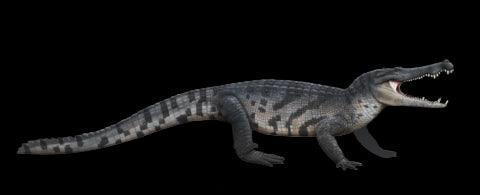


0.4 Crocodile Borealosuchus Fossil Tooth Judith River FM Montana COA Display
Location: Judith River Formation, Montana (Private Land Origin)
Weight: 0.3 Ounces
Dimensions: 0.4 Inches Long, 0.2 Inches Wide, 0.2 Inches Thick
Comes with a Certificate of Authenticity.
Comes with a Free Display.
The item pictured is the one you will receive.
Cretaceous Age through to the Eocene Age
Name: Borealosuchus (Boreal crocodile).
Named By: Chris Brochu - 1997.
Classification: Chordata, Reptilia, Crocodylomorpha, Crocodylia.
Diet: Carnivore/Piscivore.
Size: Up to 2.8 meters long, though there is some variance between species.
Time period: Campanian of the Cretaceous through to the Eocene.
Fossil representation: Skulls and postcranial remains.
Borealosuchus – Mid-Sized Crocodile of the Past
-
Origin of the Genus:
-
Established after a revision of Leidyosuchus, long considered a “wastebasket taxon”.
-
Four former species of Leidyosuchus were reassigned to Borealosuchus.
-
Two additional species have since been named under this genus.
-
-
Physical Characteristics:
-
Mid-sized crocodile genus.
-
Largest species: Borealosuchus acutidentatus.
-
Length: approximately 280 cm (2.8 meters).
-
Skull length: around 36 cm.
-
Likely a predator in rivers, lakes, and wetlands, feeding on fish and small vertebrates.
-
-
Survival and Extinction:
-
Borealosuchus survived the Cretaceous–Paleogene (K–T) extinction, which wiped out dinosaurs, pterosaurs, and many marine reptiles.
-
Other crocodile genera like Dyrosaurus and Brachychampsa also survived.
-
Likely survival factors: semi-aquatic lifestyle, physiological resilience, and ecological versatility.
-
-
Significance:
-
Demonstrates how crocodiles’ adaptations allowed them to endure catastrophic events that eliminated many other species.
-
Highlights the evolutionary success and longevity of crocodilians.
-


