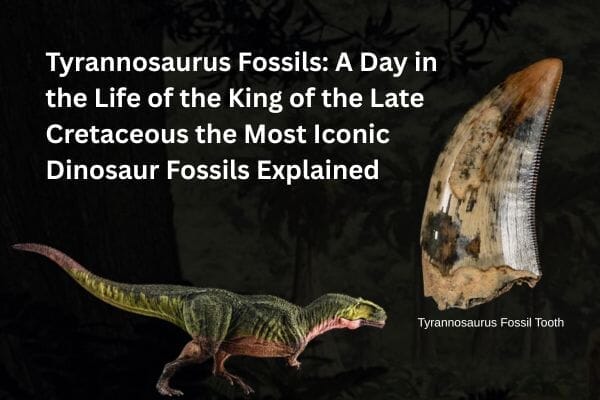
Think about waking up 66 million years ago in the green plains of Laramidia. The sun comes up and warms the ground and plants from then time. A huge shadow moves between the tall ferns and old trees. This is Tyrannosaurus, the top predator of its time. The story of its life can still be read in its bones today — some special Tyrannosaurus fossils for sale allow people and scientists to get a feel for that old world.
Sunrise in the Late Cretaceous: A T. Rex Awakens
As the sun rises, the T. rex awakens. Fossil bones, like the well-known and almost complete “Sue,” show a creature made for real strength. It had huge legs to hold up its weight. A strong tail helped it keep its balance. Its head was made to give hard, biting attacks. Even when it rested, this dinosaur was ready for anything. Its body was designed to move quickly in the event of danger or when it encountered something new. The American Museum of Natural History states that T. rex could grow up to 40 feet long. It could weigh between 5,000 and 7,000 kilograms. amnh.org
How Did T. Rex Hunt and Feed?
By mid-morning, the hunt starts. Fossils of teeth and jaws show that T. rex could bite into meat. It could also crush bones with considerable force. Studies using computer modeling suggest that adult T. rex could have had bite forces ranging from 20,000 to 57,000 N. This is one of the strongest bites of any land animal. (ScienceDaily)
-
Adult T. rex teeth had sharp edges and continued to grow back, enabling it to stay deadly in fights.
-
Bite force tests show this dinosaur could bite through big plant-eating animal bones. This shows it hunted for food and did not just eat dead animals. (National Geographic)
-
Young T. rex, as some experts suggest, had weaker bites — approximately 5,600 N — which means they likely targeted smaller animals or scavenged for dead ones to eat.
Fossils like worn teeth and poked bones show that T. rex ate big, dead animals. The dinosaur took a lot of food from each animal it caught and used almost all of it.
Did T. Rex Fight Others of Its Kind?
By the middle of the day, the animals might meet each other. T rex fossils have bite marks that got better with time. Some scratches cover each other. This shows these animals fought with their own kind. They could be fighting for land, food, or a partner. Many wounds improved, indicating that they could recover.
Young and grown animals did not compete with each other for food. This way of living is known as resource partitioning. They went after other animals for food. This helped every age group coexist in the same space.
Rest and Growth: Reading Bone Rings
Later in the day, T. rex rests. Fossil bones show growth rings, much like tree rings. These rings reveal information about age, growth cycles, and stress from the surrounding environment. The AMNH states that these rings indicate that many T. rex did not reach 30 years old. (amnh.org)
-
A young T. rex was slim and grew fast. As it aged, it changed into an adult with a thick and strong skull built for crushing bones.
-
Growth rings can indicate periods when the dinosaur experienced stress. These rings help us see the problems with weather, how well it hunted, and ways it stayed alive.
How Did T. Rex Adapt to Environmental Challenges?
Even though T. rex was the top hunter, it still had to deal with injuries, sickness, and changes in the land, like moving rivers or volcanic eruptions. Fossils show that its strong arms and legs, big tail, and tough skull helped it move through many types of ground with ease. (ScienceDaily)
Fossil Finds Today: Bringing T. Rex to Modern Hands
As night comes to the Cretaceous time, we come back to now. Fossils give us a real link to the world from long ago. With these fossils, scientists, teachers, and collectors can study how animals looked, lived, and fit into nature. Rare samples, like a t rex fossil for sale, give people a way to hold a part of history in their hands.
Fossil Age Minerals finds real, well-kept fossils. Each one comes with full records. They are taken from the earth in the right way. You can use these fossils for school, work, or just because you like them. Having one is not just owning a simple item. You get to feel closer to the animals and lives from the time of the King of the Late Cretaceous.


